
![final-logo[1]](https://rhythmcareltd.com/wp-content/uploads/elementor/thumbs/final-logo1-scaled-e1746056972397-scaled-ruqy3bwsz2r7w21yid55zivnvu9pr54am1hccjtohw.webp "final-logo[1]")

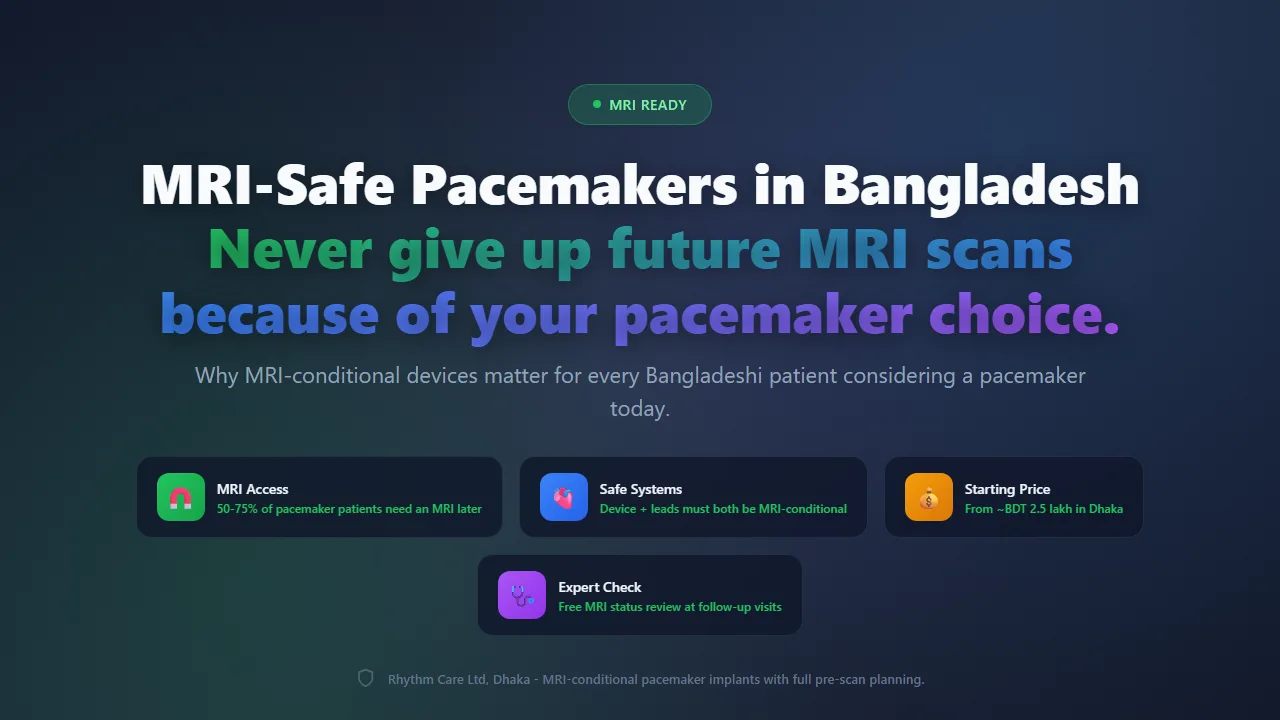
If you or a family member has a pacemaker, one question eventually comes up: “Can I ever get an MRI scan?” For decades the answer in Bangladesh was no. Patients were turned away at imaging centres, told to accept CT scans or ultrasound instead, sometimes missing out on the one test a neurologist or orthopaedic surgeon genuinely needed. That has changed. MRI-conditional pacemakers are now available in Dhaka, and at Rhythm Care Ltd we implant them routinely.
This article explains what these devices are, why they matter so much in Bangladesh, and how to know whether your existing pacemaker is MRI-safe.
Why MRI Scans Matter So Much
MRI (magnetic resonance imaging) is the best way to see soft tissue. It shows details that X-rays and CT scans simply cannot:
- Brain scans for stroke, tumours, and epilepsy
- Spine imaging for slipped discs and nerve compression
- Joint imaging for knee, shoulder, and hip problems
- Cardiac MRI for heart muscle disease and scarring
Here is the problem for Bangladesh: strokes are common here, spinal problems from years of hard physical work are common, and joint disease is common. The people who need pacemakers are often older adults, exactly the group most likely to need an MRI later in life.
Studies suggest that 50 to 75 percent of pacemaker patients will need an MRI at some point after getting their device. So when you choose a pacemaker, you are not just choosing a heart rhythm device. You are choosing whether future MRI scans stay open to you.
What Happens If a Standard Pacemaker Goes Into an MRI?
Older pacemakers were built with ferromagnetic parts. Inside an MRI machine’s powerful magnetic field, several things can go wrong:
- The device can heat up. The MRI’s radiofrequency energy can warm the leads (wires) near the heart tissue.
- Reed switch malfunction. Pacemakers use a small magnetic switch. The MRI magnet can flip it into an unexpected mode.
- Pacing interference. The magnetic field can cause rapid or inappropriate pacing.
- Battery and circuit damage. In the worst cases the device stops working properly.
This is why radiology centres in Dhaka still ask every patient with a pacemaker before scheduling an MRI, and why many still refuse.
What Does “MRI-Conditional” Actually Mean?
You will see the phrase “MRI-conditional,” not “MRI-safe.” The distinction is real.
An MRI-conditional pacemaker is designed and tested to work safely inside an MRI scanner under specific conditions:
- The device itself (pulse generator) is built without ferromagnetic parts
- The leads are specially designed to limit heating inside the scanner
- Scanning is limited to certain body regions, usually anything except direct scanning over the device
- SAR limits (a measure of MRI energy) must be respected
- The battery should have enough remaining life, often above a set threshold
In practice this means: yes, you can get a brain MRI, a spine MRI, a knee MRI. The scan team checks your device model, programs it into a special MRI mode before the scan, and restores normal settings afterwards. Thousands of such scans are done safely worldwide every year.
“MRI-safe” as a strict label technically only applies to devices proven safe in any MRI environment, which no pacemaker truly is. When clinics say “MRI-safe pacemaker,” they almost always mean MRI-conditional. It is safe when proper protocol is followed.
Which Devices Are Available in Bangladesh?
All three major manufacturers sell MRI-conditional pacemakers here:
| Brand | Popular MRI-conditional lines | Notes |
|---|---|---|
| Medtronic | Azure, Advisa | Widely used; long MRI track record |
| Abbott (St. Jude) | Assurity, Endurity, AVEIR leadless | ProScan system for pre-scan checks |
| Boston Scientific | Accent, Essentia | ImageReady MR conditioning |
Prices vary by model and features. As a rough guide, MRI-conditional single-chamber pacemakers in Bangladesh typically start around BDT 2.5 to 4 lakh, and dual-chamber models range roughly 4 to 8 lakh depending on the brand and battery life. Our detailed breakdown lives on the pacemaker price in Bangladesh page, which we update regularly.
Important: Both Device AND Leads Must Be MRI-Conditional
This detail trips up patients and even some doctors. A modern MRI-conditional generator connected to old non-conditional leads is not an approved MRI system. The whole system matters.
If you had a pacemaker implanted ten years ago and now want to upgrade, ask specifically whether your leads are MRI-conditional compatible. At Rhythm Care Ltd we check this during every follow-up visit using your device card and interrogation data, so you always know your exact MRI status.
What Should You Do Before Any MRI Scan?
If you have a pacemaker and a doctor has ordered an MRI:
- Bring your pacemaker card. It lists the manufacturer, model, and implant date.
- Tell both teams. Your cardiologist and the radiology centre must coordinate.
- Get the device checked first. Battery level and lead condition are reviewed before scanning.
- Have the device programmed into MRI mode immediately before the scan and reprogrammed back afterwards.
Never walk into an imaging centre and let them decide on the spot. A short visit to your electrophysiologist first makes the entire process smooth.
Cost Considerations
Yes, MRI-conditional pacemakers cost more than standard ones. The difference in Bangladesh is usually around 50 thousand to 1 lakh taka depending on brand.
Our honest advice: for most new implants, especially in patients under 80, the extra cost is worth paying. You are buying access to future diagnostics you cannot predict needing. The exception might be very elderly patients with limited life expectancy of the device itself, where the discussion becomes more individual.
If cost is the barrier, talk to us. We stock options across price ranges and can explain exactly what each extra taka buys. Some patients also consider an ICD (defibrillator) instead if their heart weakness warrants it; those prices are covered on our ICD price in Bangladesh page.
Real Patient Situations We See in Dhaka
Concrete examples help, because MRI decisions feel abstract until they happen to you:
A retired schoolteacher from Mirpur, implanted with an older pacemaker in 2016, developed persistent back pain. An orthopaedic surgeon recommended a spine MRI. Because his system was not MRI-conditional, he spent two years on painkillers and physiotherapy without ever getting the imaging that would have shown exactly which disc was pressing on the nerve. Had today’s devices existed at his implantation, that story would have ended differently.
A 58-year-old businessman needed a brain MRI after brief numbness in one hand. His Azure system was MRI-conditional. We programmed it into MRI mode in the morning, the scan happened that afternoon, and normal pacing resumed by evening. The scan caught a small old stroke, and his prevention medicines changed accordingly.
These cases explain why we now recommend MRI-conditional systems as the default for new implants rather than the exception.
Questions to Ask Before You Agree to Any Implant
Whether you choose Rhythm Care Ltd or another centre, ask these five questions before signing consent:
- Is this device MRI-conditional, and are the leads too?
- What is the expected battery life for my specific pacing needs?
- Which brand and model number will be implanted, and what does it cost?
- Where is the nearest follow-up facility, and does it support remote monitoring?
- If I need an MRI in five years, who coordinates the pre-scan programming?
Any centre that answers these reluctantly is telling you something.
Frequently Asked Questions
Can I have an MRI with a pacemaker implanted before 2010?
Usually not with the original system. However, some patients received conditional-compatible components without knowing it. Bring your card to us and we will confirm your exact status through device interrogation.
Does the MRI scan damage the pacemaker battery?
With a proper MRI-conditional system and correct programming mode, no meaningful battery drain occurs during a routine scan.
Is cardiac MRI possible with an MRI-conditional pacemaker?
It depends on the specific system. Many allow chest-region scanning under defined conditions, but this needs case-by-case planning between your cardiologist and radiologist.
How do I know if my pacemaker is MRI-conditional?
Check your device identification card, or visit any follow-up clinic. A five-minute device interrogation tells you definitively.
—
Need clarity about your current device or planning a new implant? Book a consultation at Rhythm Care Ltd, Dhaka, where every pacemaker plan starts with your full future in mind, not just today’s rhythm strip. Schedule your appointment here.







Leave a Comment