
![final-logo[1]](https://rhythmcareltd.com/wp-content/uploads/elementor/thumbs/final-logo1-scaled-e1746056972397-scaled-ruqy3bwsz2r7w21yid55zivnvu9pr54am1hccjtohw.webp "final-logo[1]")

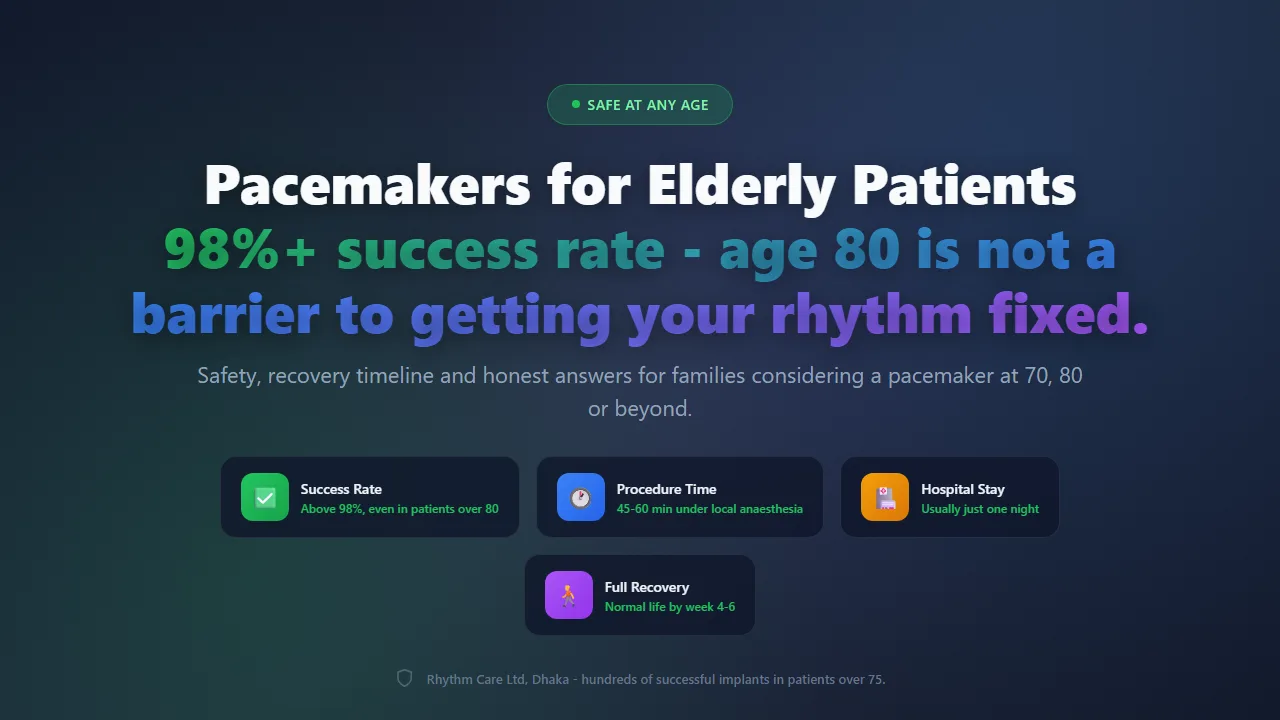
Families in Dhaka often arrive at our clinic carrying the same quiet worry: “My father is 78. Is he too old for a pacemaker?” The answer, in the overwhelming majority of cases, is no. Age alone almost never rules out pacemaker implantation. In fact, elderly patients are the group who benefit most, because slow heart rhythms are largely a disease of ageing and because a single fainting fall at 80 can break a hip and change everything.
This article walks through what families actually want to know: how safe the procedure is at an advanced age, what success looks like, and what recovery really involves.
Why Age Matters Less Than People Fear
Pacemaker implantation is not open-heart surgery. There is no chest opened, no general anaesthesia, no heart-lung machine. The procedure happens under local anaesthesia with mild sedation, usually through a small pocket made below the collarbone. For most patients it takes 45 minutes to an hour.
That matters enormously for older patients. General anaesthesia is where most surgical risk concentrates in the elderly. Remove it, and the risk profile drops dramatically. Large international registries report procedural complication rates of only 3 to 4 percent across all ages, mostly minor issues like bruising, and success rates above 98 percent. Patients in their eighties and nineties do nearly as well as younger ones when properly selected.
At Rhythm Care Ltd we regularly implant devices in patients aged 75 to 90, and the recovery stories are consistently encouraging.
Who Is Still Too Frail? Honest Assessment
While age itself is rarely a barrier, some conditions change the calculus:
- Severe dementia where the patient cannot follow post-procedure care instructions
- Life expectancy limited by advanced cancer or end-stage organ failure
- Active bloodstream infection, which must be treated first
- Uncontrolled bleeding disorders
Even then, temporary pacing options exist as a bridge. Every case deserves individual assessment rather than an automatic refusal based on birth year.
Common Concerns From Families
“He has diabetes and blood pressure.”
Both are routine. We optimise sugar control before the procedure and continue blood pressure medicines throughout. Diabetes slightly raises infection risk, which we manage with strict sterile technique and a short antibiotic course.
“She takes blood thinners.”
Most blood thinners can be continued or briefly adjusted around the procedure. This is standard planning, not a barrier.
“His kidney function is weak.”
The contrast-free nature of the procedure helps here; unlike angiograms, pacemaker implantation generally does not stress the kidneys.
“What if he is scared?”
Mild sedation keeps patients calm and comfortable. Many doze through the whole thing.
The Procedure Day, Step by Step
Knowing what happens removes much of the fear:
- Admission on the day or evening before; fasting about six hours
- Local numbing below the left or right collarbone
- A small incision, leads guided into the heart through a vein under X-ray guidance
- Device connected and placed under the skin
- Testing to confirm every setting works
- Back to the ward; most eat dinner normally that evening
Recovery Timeline for Elderly Patients
| Phase | What to expect |
|---|---|
| First 24 hours | Rest in bed or chair; monitors check the device; pain is usually mild |
| Days 2-7 | Home discharge typically next morning; keep the wound dry; arm movements restricted on the device side |
| Weeks 1-4 | Wound heals fully; avoid lifting that arm above shoulder level; light walking encouraged |
| Week 4-6 | First full device check; driving usually resumes; normal arm use returns |
| After 6 weeks | Essentially unrestricted daily life, including prayer posture, bathing, and gentle exercise |
Elderly-specific tips we give every family:
- Wound care: older skin heals slower; watch the incision daily for redness or discharge
- Sleep position: a slightly raised head helps comfort the first week; many patients prefer sleeping with a pillow under the device-side arm
- Fall prevention: arrange support for bathroom trips during week one
- Medicine review: bring all current medicines so we can adjust anything interacting with the new rhythm
Success Rate and Long-Term Outlook
Numbers worth knowing:
- Procedural success exceeds 98 percent
- Serious complications (lead dislodgement, pneumothorax, infection requiring revision) occur in roughly 1 to 2 percent
- Symptom relief is rapid; most patients stop feeling dizzy within days
- Device batteries last 10 to 15 years depending on model and pacing demand
For families weighing cost against benefit, our pacemaker price in Bangladesh guide breaks down current pricing by type and brand, including MRI-conditional models suitable for older patients who may need future scans.
When More Than a Pacemaker Is Needed
Some elderly patients have both slow rhythms and weak pumping or dangerous fast rhythms. Those patients may need an ICD (implantable cardioverter defibrillator) or CRT device instead. Pricing for those appears on our ICD price in Bangladesh page, and we explain the difference plainly during consultation before any decision.
Cost Planning for Families
Money conversations deserve honesty, because families in Bangladesh often pool resources for an elderly parent’s procedure:
- A basic reliable dual-chamber device with procedure charges typically lands around 3.5 to 5 lakh taka total
- MRI-conditional models add roughly 50 thousand to 1 lakh
- Premium long-battery models push toward 7 to 8 lakh
- Follow-up checks cost modestly per visit, usually a few thousand taka
Compare that total against the alternative costs of untreated bradycardia: one hip fracture from a faint can exceed the entire pacemaker bill, before counting the suffering. Framing the decision this way helps families who hesitate over the figure. Current model-by-model pricing is maintained on our pacemaker price in Bangladesh page.
Emotional Recovery Counts Too
Physical healing gets all the attention, but elderly patients often carry quieter worries: fear of falling again, embarrassment about being “fixed,” anxiety about the small bump under the skin. Families help most by:
- Treating the device as routine, because after six weeks it genuinely becomes invisible to daily life
- Encouraging gentle independence: let the patient manage their own medicine schedule and wound dressing with supervision rather than doing everything for them
- Watching mood; persistent low spirits after recovery warrant a mention at follow-up
Most patients report that within two months the pacemaker feels less like surgery and more like getting their ordinary life returned.
Frequently Asked Questions
Is 85 years old too old for a pacemaker?
No. Patients in their late eighties undergo successful implantation routinely. Fitness, medicines, and overall health matter more than the number.
Is the procedure done under general anaesthesia?
No. Local anaesthesia with light sedation is standard, which is exactly why elderly patients tolerate it so well.
How long does an elderly patient stay in hospital?
Usually one night. Some go home the same evening; those needing rhythm adjustment may stay two nights.
Can my mother travel back to our district after implantation?
Yes, typically after the first week’s wound check. Avoid long bumpy journeys for about ten days and carry the device card always.
—
Age should never decide whether your parent gets their life back. Talk to the team at Rhythm Care Ltd, Dhaka, about safe pacemaker implantation tailored to elderly patients. Schedule a consultation.






Leave a Comment