


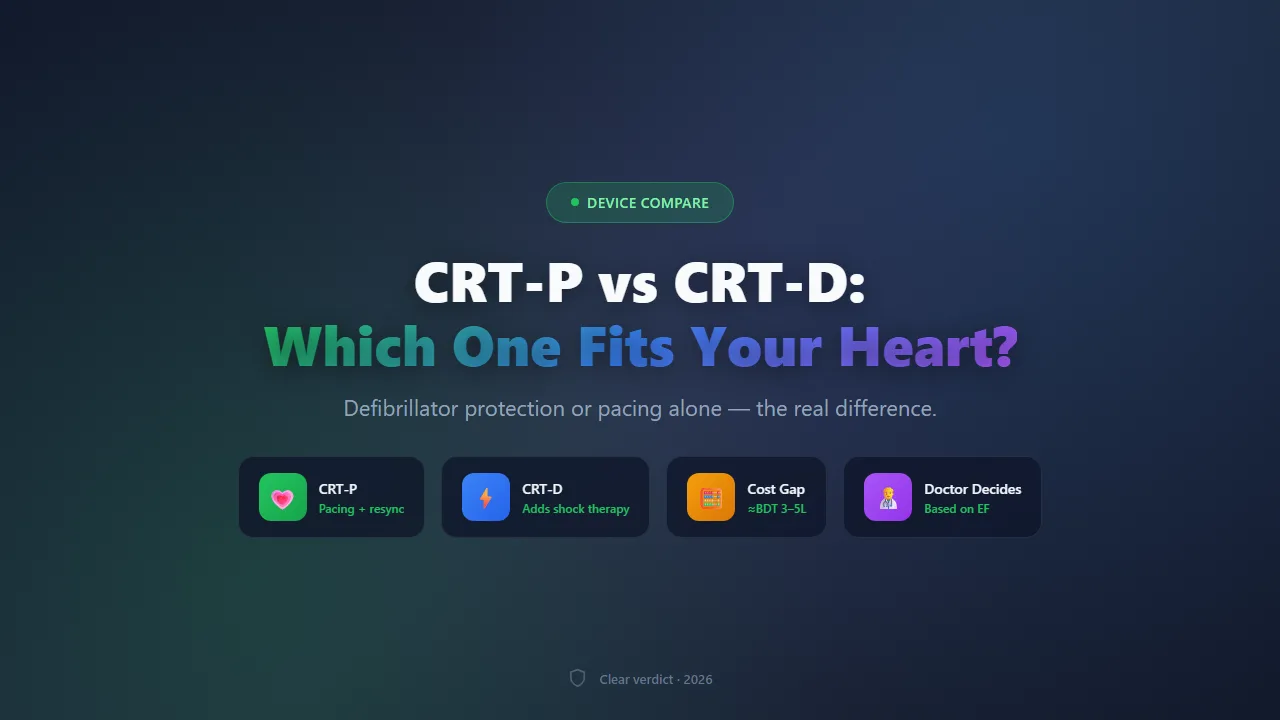
Your cardiologist has told you that you need CRT, cardiac resynchronization therapy. Then comes the question that confuses almost every patient and family: CRT-P or CRT-D? The names differ by one letter, the price differs by several lakh taka, and the right answer depends on your specific heart, not on a brochure.
This guide walks through what each device does, who benefits from which, and the exact questions to ask before you decide.
The one-sentence difference
A CRT-P is a biventricular pacemaker. It makes the two lower chambers of your heart contract together again to improve pumping efficiency.
A CRT-D is everything above plus an implantable defibrillator. It does the resynchronization work and can also deliver an internal electric shock if your heart ever goes into a lethal fast rhythm.
Both devices are implanted the same way, below the collarbone, with three leads. Recovery is identical. The difference lives inside the box and in the leads for the CRT-D.
What each device treats
Think of it as treating two separate risks:
- The pumping problem. In heart failure with electrical delay (usually left bundle branch block), parts of the ventricle squeeze out of sync. Both CRT-P and CRT-D fix this.
- The rhythm risk. A very weak heart can suddenly develop ventricular tachycardia or fibrillation, rhythms that cause cardiac arrest within minutes. Only the CRT-D can stop these.
So the choice comes down to whether you carry meaningful risk of sudden arrhythmic death on top of your pumping failure.
How doctors actually choose
Cardiologists use fairly consistent criteria, drawn from large international trials:
CRT-D is usually recommended when:
- Your ejection fraction is 35% or lower
- You have survived a cardiac arrest or documented dangerous ventricular rhythms before
- Scarring from a previous heart attack puts you at high arrhythmia risk even if you have never had an event
- You are expected to live more than about a year with reasonable function, so the defibrillator benefit has time to matter
CRT-P may be appropriate when:
- Your ejection fraction sits in a range where arrest risk is modest
- You have mainly conduction disease and symptoms rather than severe pump failure
- Advanced age or other serious illness makes long-term benefit from defibrillation unlikely
- Cost constraints are real and your individual risk profile does not justify the higher device price
Two honest points worth hearing. First, guidelines generally lean toward CRT-D when the ejection fraction is 35% or below, because the trials supporting that number are strong. Second, a CRT-P chosen only to save money, against medical advice, trades a life-saving function for a few lakh taka, which most families regret if the event ever happens.
Side by side comparison
| Feature | CRT-P | CRT-D |
|---|---|---|
| Fixes desynchronized pumping | Yes | Yes |
| Treats lethal fast rhythms | No | Yes |
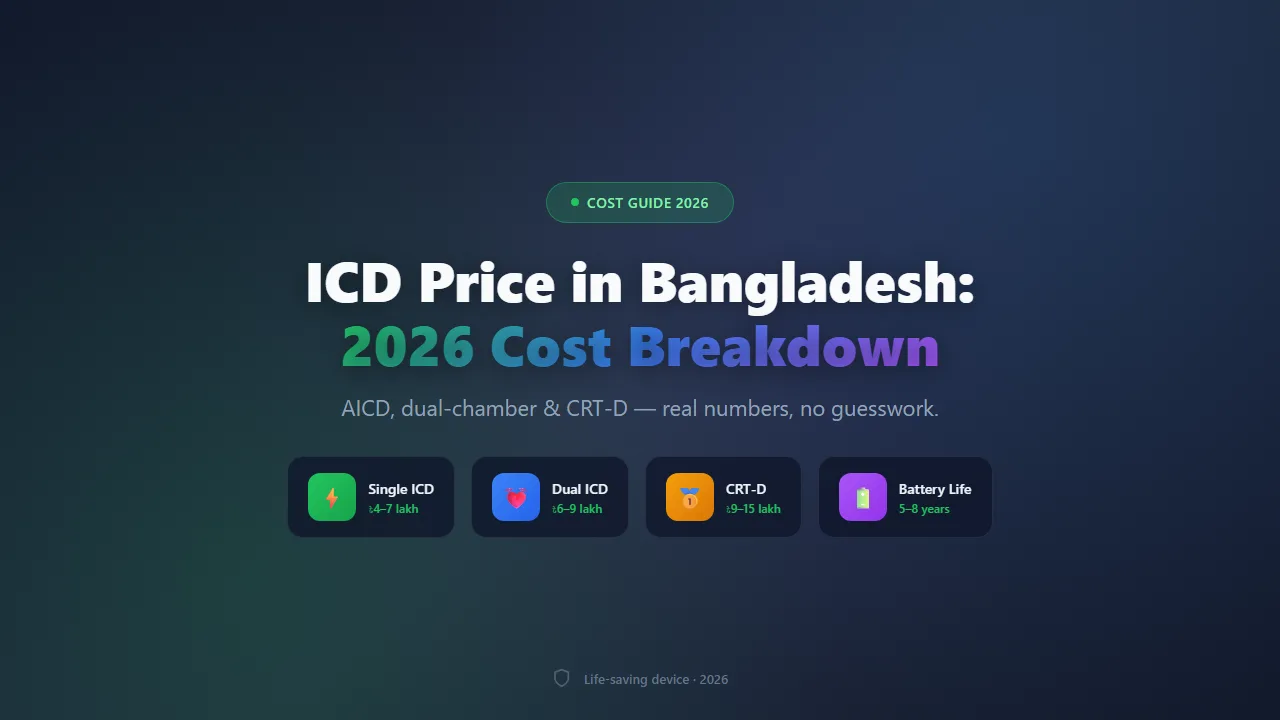
| Typical device price in Bangladesh | BDT 5,00,000 – 8,50,000 | BDT 9,00,000 – 15,00,000+ |
| Implantation procedure cost | BDT 80,000 – 1,50,000 | BDT 80,000 – 1,50,000+ |
| Battery life expectation | Roughly 6–10 years | Roughly 5–8 years |
| Shock sensation possible | No | Yes, brief and strong if it fires |
What living with a CRT-D feels like
One thing patients should know beforehand: if a CRT-D ever fires, it is not subtle. Patients describe a kick or thump in the chest lasting an instant. It is frightening but it means the device just stopped a potentially fatal rhythm, which is exactly its job. Occasional inappropriate shocks can happen too, usually triggered by fast harmless rhythms, and these are corrected by reprogramming at follow-up.
A CRT-P never shocks. If peace of mind about shocks matters to you psychologically, mention it at consultation; it is a legitimate factor, though not one that should override survival indications.
Costs compared in Bangladesh terms
Device prices in Bangladesh are regulated by DGDA, so the same model costs similar amounts across hospitals. The realistic all-in picture for 2026:
- CRT-P package: roughly BDT 6,00,000 to 10,00,000 including procedure and hospital stay
- CRT-D package: roughly BDT 10,00,000 to 16,50,000 including procedure and hospital stay
Add long-term items either way: follow-up checks every few months, eventual battery replacement (a full new device cost), and continued heart failure medicines. Some insurance policies reimburse part of the cost with pre-authorization; check before scheduling.
Five questions to ask your electrophysiologist
Bring these to your consultation:
- What is my ejection fraction, and how many times has it been measured?
- Do I have any evidence of dangerous ventricular rhythms, on Holter monitoring or otherwise?
- Are you recommending CRT-D because of my arrest risk specifically? Please explain my numbers.
- Which brand and model, why that one, and what is its expected battery life?
- What is the total package cost, and what will follow-up cost per year?
If a doctor cannot answer these plainly, get a second opinion. Rhythm Care Ltd provides CRT evaluation in Dhaka, reviews your echo and ECG findings, and explains both device options with real numbers. Book an appointment and bring your reports.
Frequently asked questions
What is the difference between CRT-P and CRT-D in one line?
Both fix desynchronized pumping; only the CRT-D also contains a defibrillator against lethal rhythms.
Why is CRT-D so much more expensive?
It contains high-voltage defibrillation hardware, a larger battery and specialized leads on top of the pacing system.
Can I start with CRT-P and upgrade later?
Yes, upgrades are possible, though they involve an additional procedure and cost more than implanting the right device initially in some cases.
Does insurance cover either device?
Some corporate and private policies reimburse part of the device cost with pre-authorization obtained before surgery.
Is recovery different for the two devices?
No. Implantation technique and healing are essentially identical; both need about four weeks of gentle arm use.
The bottom line
Both devices fix the coordination problem that makes heart failure worse. Only the CRT-D also guards against sudden cardiac death. The decision rests on your ejection fraction, your rhythm history, and your overall health outlook, measured properly and explained honestly. When those numbers are on the table, the choice usually becomes clear.






Leave a Comment