
![final-logo[1]](https://rhythmcareltd.com/wp-content/uploads/elementor/thumbs/final-logo1-scaled-e1746056972397-scaled-ruqy3bwsz2r7w21yid55zivnvu9pr54am1hccjtohw.webp "final-logo[1]")

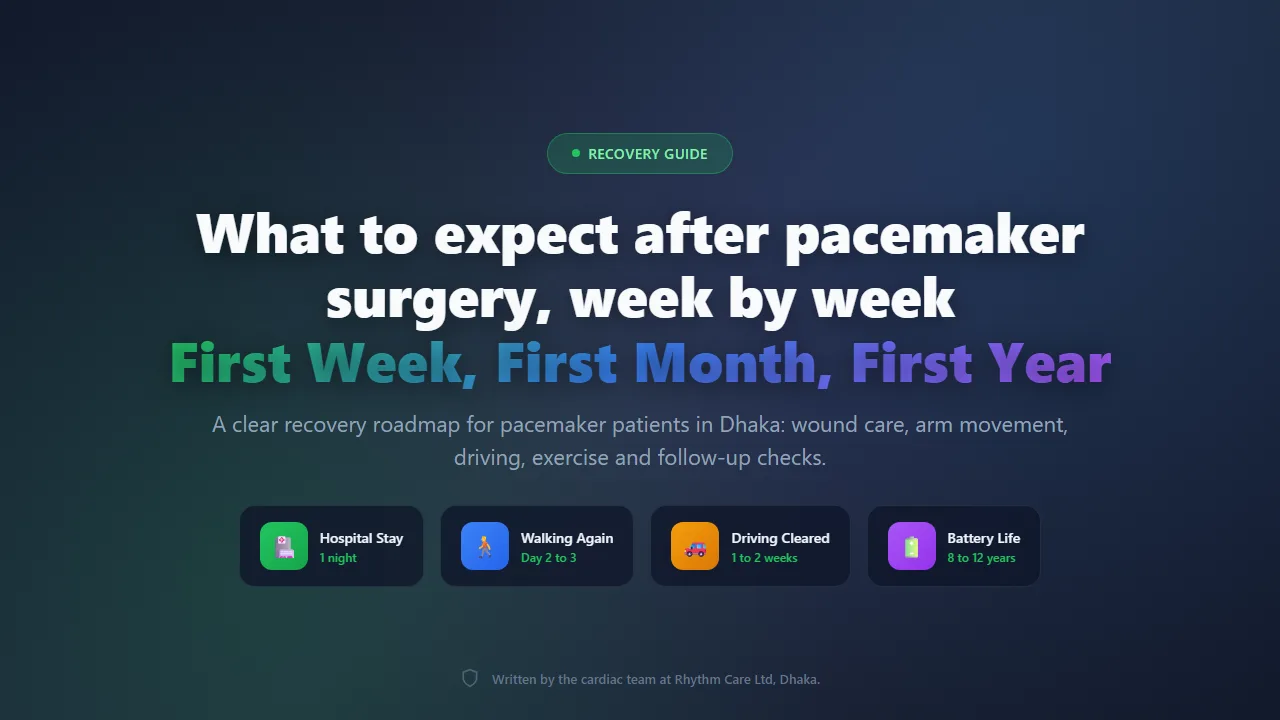
A pacemaker is a small device that keeps your heart beating at a safe rhythm. The surgery itself usually takes one to two hours, and most patients in Dhaka go home the next morning. But many families ask us the same question afterwards: how long until life feels normal again?
The honest answer is that recovery happens in stages. Your body heals the incision within weeks, but your confidence returns more slowly. This guide walks you through what to expect in the first week, the first month, and the first year after pacemaker surgery, based on what we see every day at Rhythm Care Ltd in Dhaka.
The First 48 Hours: Hospital Stay
Most patients stay one night in hospital after the procedure. The pacemaker is implanted under the skin near your collarbone, usually on the left side, with thin wires (leads) guided into the heart through a vein.
During this time:
- Nurses monitor your heart rhythm continuously to confirm the pacemaker is working correctly.
- You may feel some soreness or a pulling sensation near the incision site. Mild painkillers handle it easily.
- You will be told to keep the arm on the implant side close to your body and avoid lifting it above shoulder height.
- Most people eat normally, walk to the bathroom with help, and sleep fine the same night.
Before discharge, the electrophysiologist checks your device settings and gives you a device card. Keep that card in your wallet at all times. It matters at airport security and in any emergency room.
The First Week at Home
The first week is about rest and wound care, not about testing yourself.
Wound care: Keep the incision clean and dry. A light shower is allowed after 2 to 3 days if your doctor agrees, but do not rub the area. Do not apply any powder, oil, or home remedies to the wound. If you notice increasing redness, swelling, warmth, or fluid leaking from the incision, contact your doctor the same day.
Arm movement: You can use your implant-side arm for eating, writing, and light tasks at waist level. Do not lift that arm above your shoulder and do not lift anything heavier than about 2 to 3 kilograms, roughly the weight of a small water bottle or a newborn baby.
Sleeping: Sleep on your back or on the side away from the implant for comfort. Some patients place a small pillow under the armpit to remind themselves not to roll onto the device side.
Activity: Short walks inside the house are encouraged from day two or three. Walking improves circulation and prevents stiffness. Avoid stairs beyond what you must climb, and arrange help for cooking and shopping during this week.
A follow-up visit to check the wound and device settings is usually scheduled 7 to 10 days after surgery. In Dhaka, plan transport ahead of time so the ride is smooth and unhurried.
Weeks 2 to 4: Building Back Gently
By the second week, most patients feel noticeably better. The soreness fades, the incision begins to close properly, and energy levels rise. This is also when patients sometimes get overconfident, so hold these lines:
- Still no lifting above shoulder height with the implant arm.
- No driving yet in most cases (more on driving below).
- Walking distance can grow steadily. Aim for 15 to 20 minutes twice a day by week three.
- Return to desk work may be possible around week two if your job involves no heavy strain.
Your first month check-up typically happens around 4 to 6 weeks. At this visit the doctor reads the device remotely or in clinic, adjusts settings if needed, and clears you for more normal movement. Wound healing in Bangladeshi patients is generally good, but diabetes slows healing, so if you are diabetic, keep blood sugar under tight control during this period.
When can you drive?
For a routine pacemaker, most doctors allow driving after 1 to 2 weeks once the incision is stable and you can move freely without pain. If you had a major cardiac event before surgery, the waiting period may be longer. Always confirm with your own cardiologist rather than following general advice.
Months 2 to 6: Returning to Normal Life
By the second month, the leads are firmly anchored in the heart tissue. This is the milestone that unlocks most activities:
- Full range of motion in both arms, including reaching overhead.
- Swimming and bathing without restrictions once the wound has fully healed.
- Moderate exercise such as brisk walking, cycling, or treadmill work.
- Resuming prayers. Many patients ask about sujood; by month two, the gentle pressure is no longer a concern for the incision, though discuss timing with your doctor.
Exercise should build gradually. A simple rule: you should be able to talk while walking briskly. If you become breathless enough that speech is hard, slow down. Chest pain, fainting, or palpitations during activity are reasons to stop and call your doctor.
The One-Year Mark
At one year, most patients have essentially forgotten the device is there. Regular life, travel, work, and family duties all resume. Two things remain permanent:
- Device checks: Your pacemaker is reviewed every 6 to 12 months, either in clinic or through remote monitoring. These visits take 15 to 20 minutes and keep the battery and leads confirmed healthy.
- Battery awareness: A modern pacemaker battery lasts 8 to 12 years. Replacement is a smaller procedure than the original implant because only the generator changes, not the leads.
Recovery Timeline at a Glance
| Period | What you can do | What to avoid |
|---|---|---|
| Days 1 to 2 | Walk short distances with help | Lifting the implant arm above shoulder |
| Week 1 | Light household activity, showers after day 3 | Driving, lifting over 2 to 3 kg, wetting the wound early |
| Weeks 2 to 4 | Desk work, longer walks, gentle stretching | Overhead reaching, swimming, heavy pulling |
| Months 2 to 3 | Driving, moderate exercise, swimming, travel | Contact sports, heavy gym lifting |
| Months 6 to 12 | Nearly all normal activities | Only rough contact sports remain restricted |
| Year 1 onward | Routine checks every 6 to 12 months | Nothing special; carry your device card |
Costs and Follow-Up Care in Dhaka
Pacemaker implantation cost in Bangladesh depends mainly on the device itself. Locally made and Indian devices start lower, while imported European and American devices with advanced features sit higher. As a broad guide, expect packages from around 2 lakh taka for basic single-chamber devices up to 10 lakh or more for premium dual-chamber systems, including hospital charges. For a current breakdown, see our page on pacemaker price in Bangladesh.
Follow-up device checks in Dhaka typically cost between 2,000 and 5,000 taka per visit. Budget for these; skipping them risks missing battery or lead problems that are easy to fix when caught early.
A Word for Family Members
Recovery goes better when the household understands the rules too. Brief the people who cook, shop, and drive for you:
- Nobody should hand heavy shopping bags or a grandchild to a patient in week one; two to three kilograms is the ceiling.
- Bathroom floors should be dry and non-slippery during the early weeks when movement feels stiff.
- Someone should know where the device card lives and which number to call if dizziness or fainting happens.
- Family members can learn CPR. If your spouse or adult child takes one training session, everyone in the house sleeps easier.
Small preparations like these prevent most of the avoidable problems we see after implantation: pulled leads from lifting luggage, infected wounds from homemade poultices, and panicked ambulance rides over symptoms that needed only a phone call.
Warning Signs That Need Same-Day Attention
Call your doctor immediately if you experience any of these after pacemaker surgery:
- Fever above 100 degrees F with wound redness or discharge
- Swelling or bleeding at the implant site
- Fainting, dizziness, or a return of the symptoms that led to the pacemaker
- Hiccups that pulse in rhythm with the heartbeat (a sign of lead movement)
- Persistent shortness of breath or chest pain
These situations are uncommon. At Rhythm Care Ltd we give every patient a direct phone number for exactly this reason, and same-day review slots are kept open for post-implant concerns.
Frequently Asked Questions
How soon can I sleep on the pacemaker side?
Wait about 4 weeks, or until your doctor confirms the pocket has healed. Sleeping on the other side avoids pressure on the fresh incision.
Will my phone interfere with the pacemaker?
No. Holding a phone against the ear is fine. Just avoid carrying a switched-on phone in the breast pocket directly over the device.
Can I go through airport security?
Yes. Show your device card, walk through the arch briefly without lingering, and request a hand check if you prefer. Modern scanners do not damage devices.
Does the pacemaker pain continue for months?
No. Incision soreness settles within 2 to 4 weeks. Pain lasting longer deserves a review to rule out lead or pocket issues.
Take the Next Step
If you or a family member is planning pacemaker surgery or recovering from one, our team at Rhythm Care Ltd in Dhaka will walk you through every stage of recovery. Book a consultation today at /appointment/.







Leave a Comment