
![final-logo[1]](https://rhythmcareltd.com/wp-content/uploads/elementor/thumbs/final-logo1-scaled-e1746056972397-scaled-ruqy3bwsz2r7w21yid55zivnvu9pr54am1hccjtohw.webp "final-logo[1]")

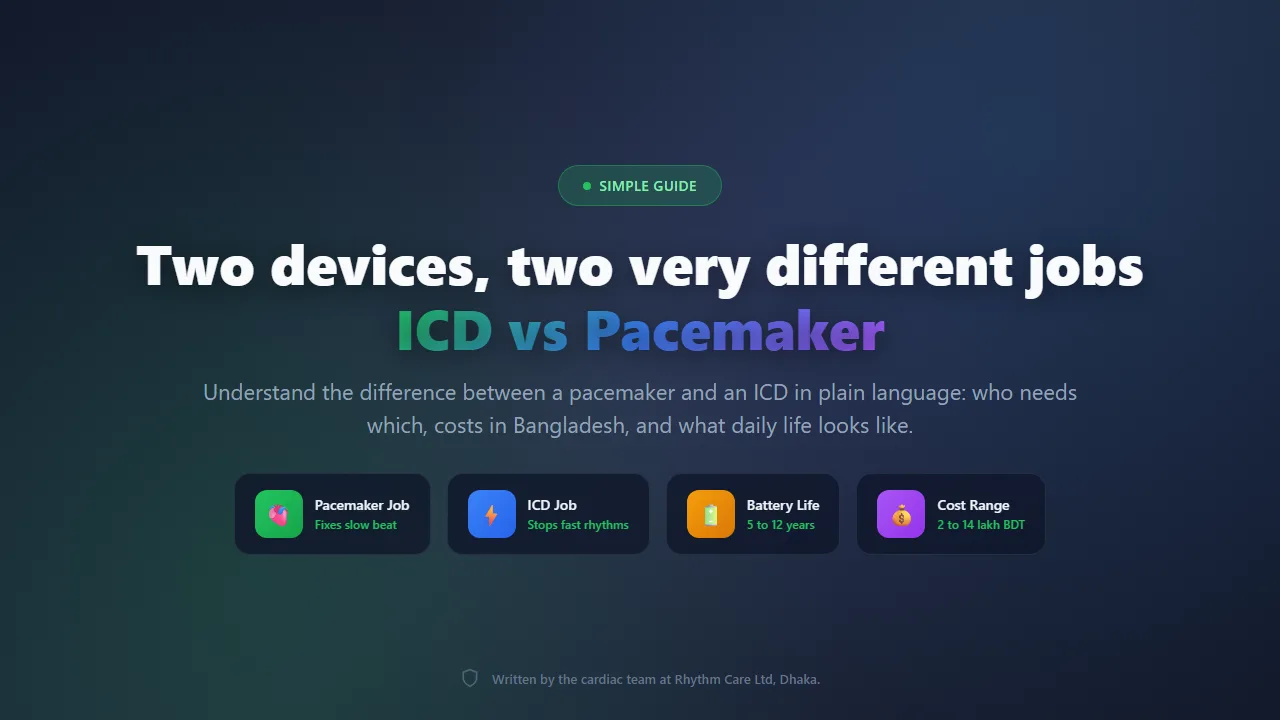
Families often arrive at our Dhaka clinic holding two different prescriptions from two different doctors: one says pacemaker, another says ICD. The confusion is understandable. Both are small devices implanted near the collarbone, both connect to the heart with wires, and both treat rhythm problems. But they do very different jobs, and choosing the wrong one leaves a patient unprotected.
This guide explains the difference in plain language, without medical jargon, so you can understand what each device does and why your cardiologist recommended one over the other.
The Simplest Explanation
Think of your heart as a house with an electrical system.
- A pacemaker is like a backup generator. When the heart’s natural electrical supply runs too slow or stops, the pacemaker steps in and sends small signals to keep the beat going. It prevents pauses and slow rates.
- An ICD (implantable cardioverter defibrillator) is like a fire extinguisher plus the generator. It does everything a pacemaker does, and on top of that it watches constantly for dangerously fast rhythms. If the heart races into ventricular tachycardia or fibrillation, the ICD delivers an electric shock to reset it. That shock can be the difference between life and death.
So a pacemaker fixes a slow heart. An ICD guards against a heart that suddenly beats too fast to pump blood. Many modern ICDs include full pacemaker function as well.
Side-by-Side Comparison
| Feature | Pacemaker | ICD |
|---|---|---|
| Main job | Speeds up a slow heartbeat | Stops dangerous fast rhythms |
| Who needs it | Heart block, sick sinus syndrome, slow pulse | Weak heart muscle, survived cardiac arrest, inherited risk |
| Delivers shocks | No | Yes, when needed |
| Typical size | Slightly smaller and lighter | Slightly larger |
| Battery life | 8 to 12 years | 5 to 8 years |
| Cost in Bangladesh | Roughly 2 to 8 lakh taka | Roughly 5 to 14 lakh taka |
| Daily restrictions | Almost none after healing | Driving limits, magnet and metal precautions |
Why Would Someone Need an ICD Instead?
An ICD is recommended when the risk of sudden cardiac arrest is high. Common reasons include:
- Previous cardiac arrest or ventricular fibrillation. If your heart has already stopped once, an ICD is the standard protection worldwide.
- Very weak pumping function. When the ejection fraction (the percentage of blood the heart pumps out with each beat) stays below 35 percent despite medication, guidelines support an ICD.
- Inherited conditions. Families with hypertrophic cardiomyopathy, long QT syndrome, Brugada syndrome, or a history of sudden death in young relatives often need ICDs.
- Certain heart failure cases where scarring from a previous heart attack creates a substrate for fast, dangerous rhythms.
A pacemaker alone cannot stop a cardiac arrest. It paces a slow heart, but it cannot shock a racing one back into order.
Can One Device Be Both?
Yes. Modern ICDs perform pacing too, so a patient who needs both slow-rate support and shock protection gets a single device. There are three main configurations:
- Single-chamber ICD: one lead in the right ventricle.
- Dual-chamber ICD: leads in the right atrium and ventricle, useful when the top chambers also misbehave.
- CRT-D (cardiac resynchronization therapy defibrillator): three leads that help a weak, poorly coordinated heart pump more efficiently. Recommended for some heart failure patients.
Your electrophysiologist picks the configuration after an ECG, echocardiogram, Holter monitoring, and sometimes an electrophysiology study.
What the Implantation Involves
Both procedures are similar in practice:
- Local anesthesia with light sedation; you stay comfortable and mostly awake.
- A small cut below the collarbone, leads guided through a vein into the heart.
- The generator placed under the skin and connected to the leads.
- Device tested, wound closed, one night in hospital.
Total procedure time is one to two hours. Most patients in Dhaka return home the next morning and recover over four to six weeks. The ICD pocket is slightly larger, so initial soreness can be a bit more noticeable.
Living With Each Device
Daily life is broadly similar. Both devices need periodic checks, and neither stops you from working, travelling, or praying. Differences worth knowing:
- Driving: After an ICD, driving is paused longer, commonly several weeks to months depending on whether the device was placed preventively or after an actual arrest. Pacemaker drivers usually restart within one to two weeks.
- Phone and magnets: Both devices dislike strong magnetic fields. Keep phones out of the chest pocket, avoid induction cooktops up close, and tell security staff about the device using your card.
- Shocks: A pacemaker never shocks. An ICD may deliver a shock during a dangerous rhythm, which feels like a strong thump in the chest. One isolated shock followed by feeling well means calling your doctor the next day; repeated shocks mean going to the emergency room.
We cover daily-life rules in detail in our guide on living with an ICD.
Cost Comparison in Bangladesh
Price differences come almost entirely from the device hardware.
| Item | Approximate cost (BDT) |
|---|---|
| Basic single-chamber pacemaker package | 2 to 4 lakh |
| Dual-chamber pacemaker package | 4 to 8 lakh |
| Single/dual-chamber ICD package | 5 to 9 lakh |
| CRT-D system | 10 to 14+ lakh |
These figures include the device, procedure, and hospital stay but vary with brand (Medtronic, Abbott, Boston Scientific, Biotronik), hospital, and doctor fees. For updated numbers read our pages on pacemaker price in Bangladesh and ICD price in Bangladesh.
Ask any hospital for a written itemized estimate before admission. Reputable centres in Dhaka provide one without hesitation.
How the Decision Is Actually Made
If you are wondering how a cardiologist settles between these devices, here is the thought process in order:
- Measure the pumping strength. An echocardiogram gives the ejection fraction. Below 35 percent after proper medication pushes the conversation toward an ICD.
- Check the rhythm history. Fainting spells, documented fast rhythms, or a survived arrest all raise the stakes toward defibrillator protection.
- Look at the ECG pattern. Heart block and sick sinus syndrome point to a pacemaker; inherited channel conditions point to an ICD.
- Ask about the family tree. Unexplained sudden deaths in relatives under 50 change the risk maths entirely.
- Weigh overall health and wishes. Device decisions belong to a dialogue, not a prescription pad.
Bring your reports to any consultation and ask the doctor to walk through these five steps aloud with your numbers. A specialist who explains the reasoning clearly is usually a specialist worth trusting with the implant.
Frequently Asked Questions
Is an ICD more risky than a pacemaker?
The implantation risk is nearly identical. The difference afterwards is that ICDs can deliver shocks, which some patients find distressing, though the shocks save lives.
Can a pacemaker be upgraded to an ICD later?
Sometimes, yes, if risk status changes. It usually requires a new generator and possibly extra leads, planned by your electrophysiologist.
Which device lasts longer?
Pacemakers, typically. Their batteries drain slowly; ICD batteries reserve power for potential shocks, giving 5 to 8 years on average.
My father got an ICD after a heart attack. Does he still need medicines?
Absolutely. Devices protect against arrhythmia; medicines protect the heart muscle itself. They work together, not instead of each other.
Get a Clear Answer for Your Case
If you are unsure whether you or a relative needs a pacemaker, an ICD, or nothing at all, bring your ECG and echo reports to Rhythm Care Ltd in Dhaka. We will explain your options plainly and honestly. Book a consultation at /appointment/.






Leave a Comment