
![final-logo[1]](https://rhythmcareltd.com/wp-content/uploads/elementor/thumbs/final-logo1-scaled-e1746056972397-scaled-ruqy3bwsz2r7w21yid55zivnvu9pr54am1hccjtohw.webp "final-logo[1]")

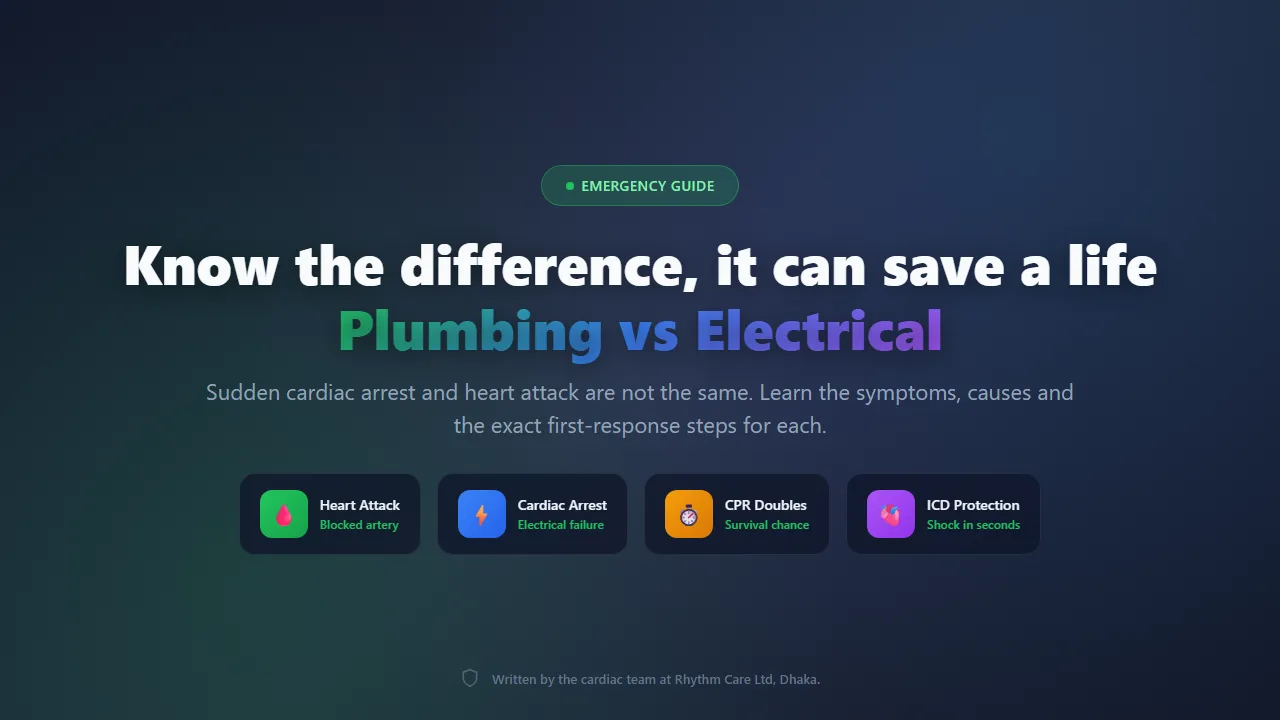
In Bangladesh, people use “heart attack” for every cardiac emergency. When a relative collapses at the mosque or in the office, neighbours say he had a heart attack. Sometimes that is true. Often it is not. A heart attack and a sudden cardiac arrest are two different events with different causes, different first responses, and very different survival odds without immediate action.
Knowing the difference matters because the correct response to a cardiac arrest, CPR and a defibrillator within minutes, is the only thing that works. This guide explains both conditions simply and tells you exactly what to do.
The Plumbing Problem vs the Electrical Problem
The easiest way to understand the difference:
- A heart attack is a plumbing problem. One of the coronary arteries supplying blood to the heart muscle gets blocked, usually by a clot forming on a cholesterol plaque. Part of the heart muscle starts dying from lack of oxygen. The heart usually keeps beating.
- Sudden cardiac arrest (SCA) is an electrical problem. The heart’s rhythm suddenly turns chaotic (ventricular fibrillation) or stops entirely. The heart quivers instead of pumping, blood flow to the brain stops, and the person loses consciousness within seconds. Arrest can happen even in hearts that were never blocked.
The two are related but not the same. A large heart attack can trigger a cardiac arrest, which is why arrest risk rises after infarction. But many arrests happen without any heart attack at all, especially in people with weak heart muscles or inherited rhythm disorders.
Comparing the Two Side by Side
| Feature | Heart attack | Sudden cardiac arrest |
|---|---|---|
| Cause | Blocked coronary artery | Chaotic or absent electrical rhythm |
| Onset | Usually gradual over minutes to hours | Seconds, without warning |
| Consciousness | Patient stays awake, in pain | Patient collapses unconscious |
| Breathing | Normal or laboured | Absent or gasping (agonal) |
| Pulse | Present | No detectable pulse |
| Main treatment | Emergency angioplasty to open the artery | Immediate CPR and defibrillation |
| Survival without treatment | Often survives if treated within hours | Dead within minutes |
Symptoms: How Each One Announces Itself
Heart attack warning signs
Heart attacks often give hours of notice:
- Central chest pressure, heaviness, or burning lasting more than 15 minutes
- Pain spreading to the left arm, jaw, neck, or back
- Cold sweat, nausea, shortness of breath
- In diabetic patients and many women, symptoms may be mild or unusual: just fatigue, jaw discomfort, or indigestion-like feeling
A person having a heart attack is usually awake, frightened, and able to talk about the pain.
Cardiac arrest warning signs
Cardiac arrest announces itself differently:
- Sudden collapse with no response when you shout or shake them
- No normal breathing, or strange gasping breaths
- No pulse
- Skin turning grey or blue within a minute
Some people get warning signs minutes before an arrest: racing heartbeat, dizziness, fainting spells, or chest pain. But roughly half of arrests strike without any prior symptom. That is why protection for high-risk patients means an ICD rather than watchfulness alone.
What To Do: The First 5 Minutes Decide Everything
If you suspect a heart attack
- Call your emergency number or arrange transport to the nearest hospital with cath lab facilities immediately. In Dhaka, know your nearest cardiac hospital in advance.
- Have the patient chew one soluble aspirin (300 mg) unless they are allergic or have active bleeding.
- Keep them seated, calm, and still. Do not let them walk around.
- Do not wait for symptoms to pass. Time equals heart muscle; every 30 minutes of delay measurably increases damage.
If someone collapses (suspected cardiac arrest)
- Check response and breathing. If no response and no normal breathing, it is an arrest.
- Start chest compressions immediately: push hard and fast in the centre of the chest, about 100 to 120 compressions per minute, allowing full recoil between pushes. Press at least 5 cm deep.
- Send someone to call an ambulance and find an AED if available. Continue compressions with minimal interruption.
- If an AED arrives, switch it on and follow its voice instructions. It will only shock if a shockable rhythm exists.
- Keep going until the ambulance team takes over or the person starts responding.
CPR doubles or triples survival from out-of-hospital arrest. In Bangladesh, bystander CPR remains rare, mostly because nobody nearby knows how. Learning it once, in a two-hour session, equips you to save a life at home. We encourage every family with a cardiac patient to learn basic CPR.
Why Some People Need an ICD Rather Than Luck
Surviving one cardiac arrest does not remove the risk of another; it usually raises it. Worldwide guidelines are clear on this:
- Anyone who survived a ventricular fibrillation arrest not caused by a fully reversible problem should receive an ICD before discharge.
- Patients with ejection fraction below 35 percent despite three months of proper medication qualify for a preventive ICD.
- People with inherited conditions such as hypertrophic cardiomyopathy, Brugada syndrome, or long QT syndrome, and families with unexplained young sudden deaths, need rhythm-risk assessment.
An ICD is a small device implanted under the collarbone that watches the heart around the clock and delivers a life-saving shock within seconds of a dangerous rhythm. For patients in Dhaka, we explain candidacy, procedure, and pricing in our guides on who needs an ICD and ICD price in Bangladesh.
Building a Heart-Safe Household
Emergency response is not an individual skill; it belongs to the family. In most Bangladeshi homes, the person who collapses does so with relatives nearby, so what those relatives know decides the outcome.
Practical steps every cardiac family should take:
- At least two adults learn hands-only CPR. Community health centres and some private hospitals in Dhaka run short courses; even watching a verified training video together beats knowing nothing.
- Keep a written card on the fridge with the patient’s diagnoses, medicines, doses, and the clinic’s phone number.
- Save the nearest 24-hour cardiac hospital’s address in every family member’s phone, mapped in advance.
- Agree in advance who calls the ambulance, who unlocks the gate, who rides along. Deciding during a crisis wastes minutes.
- Keep aspirin at home and know whether the patient may take it.
None of this costs meaningful money. It costs one conversation and half an hour of preparation, and it converts a household into a first-response team.
Risk Factors Both Conditions Share
Much of the prevention overlaps, which is good news:
- Smoking (the single most common avoidable factor among Bangladeshi men)
- Uncontrolled diabetes and high blood pressure
- High cholesterol
- Obesity and physical inactivity
- Family history of early heart disease or sudden death
Additional arrest-specific risks include prior infarction with scarring, heart failure, and certain genetic rhythm diseases. A simple ECG plus echocardiogram catches most of these; both take under an hour at any rhythm clinic.
Frequently Asked Questions
Can a heart attack cause cardiac arrest?
Yes. A major heart attack irritates the heart muscle and can trigger ventricular fibrillation. This is why suspected heart attacks belong in hospital, not at home.
Does the person feel pain during cardiac arrest?
No. Loss of consciousness happens within seconds, so there is no pain. The danger is death within minutes without CPR and defibrillation.
Can cardiac arrest be prevented?
Partly. Controlling risk factors lowers overall risk, and high-risk patients get direct protection from an ICD, which treats dangerous rhythms the moment they start.
Is gasping after collapse a sign of breathing?
No. Agonal gasping is a sign of cardiac arrest, not breathing. Start compressions.
Learn Your Risk Today
If you have survived a heart attack, have a weak heart, or lost a young relative to sudden death, get assessed at Rhythm Care Ltd in Dhaka. Ten minutes with an ECG and echo can tell whether you need protection. Book now at /appointment/.





Leave a Comment