
![final-logo[1]](https://rhythmcareltd.com/wp-content/uploads/elementor/thumbs/final-logo1-scaled-e1746056972397-scaled-ruqy3bwsz2r7w21yid55zivnvu9pr54am1hccjtohw.webp "final-logo[1]")

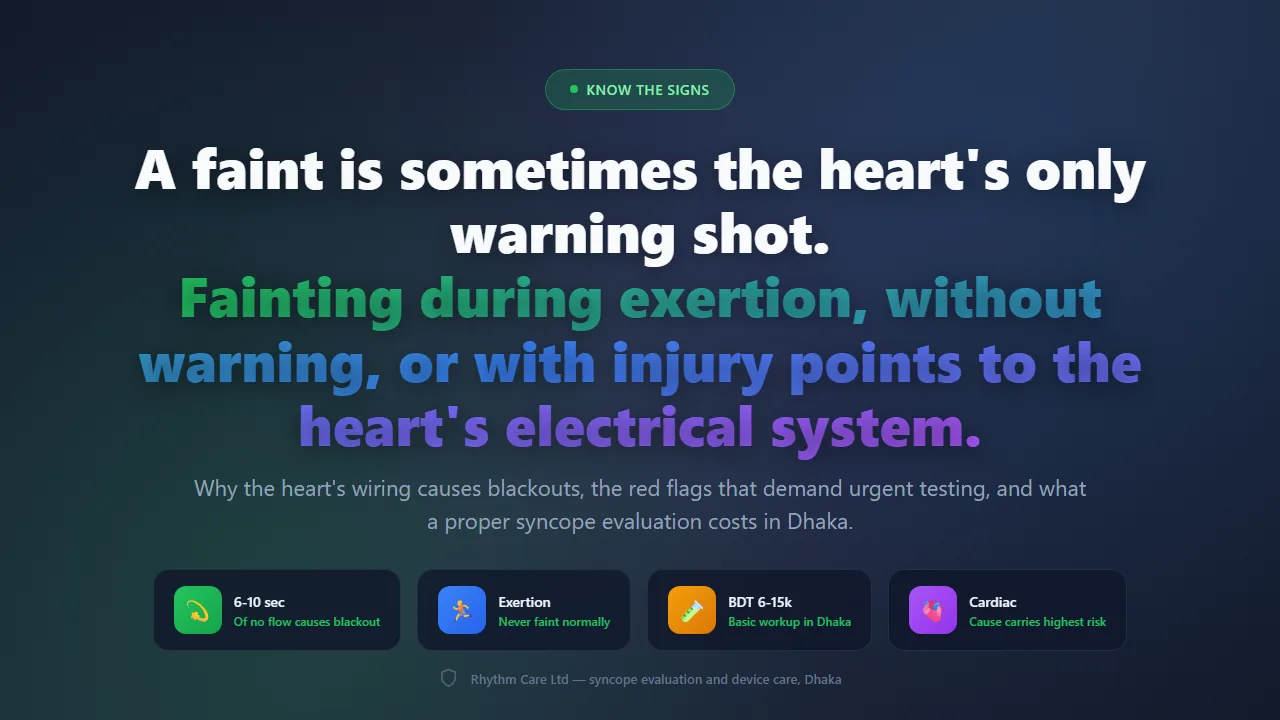
Fainting is one of the most misunderstood symptoms in medicine. Families watch someone collapse, revive within a minute, and conclude it was low blood pressure, or weakness from skipping meals, or “just gas,” a diagnosis Bangladesh has generously distributed for generations. Sometimes that’s true. But a meaningful share of faints and dizzy spells trace back to the heart’s electrical system, and those are the ones you cannot afford to mislabel.
The stakes are concrete. Cardiac syncope, meaning fainting caused by a heart rhythm problem or structural heart disease, carries a significantly higher risk of sudden death than other causes. Studies consistently show that people with cardiac syncope have worse outcomes over the following year than people who fainted for benign reasons. The faint itself isn’t the emergency. It’s the warning shot before a possible lethal arrhythmia.
Why the heart’s wiring causes dizziness
Your brain tolerates interruption of blood flow poorly. Cut off circulation for about six to ten seconds and you lose consciousness. The heart is what maintains that flow, so anything that makes the heart stop pumping effectively, even briefly, produces lightheadedness first and blackout second.
Three electrical mechanisms do this:
Slow rhythms (bradycardia). The sinus node, the heart’s natural pacemaker, can fail intermittently, or the signal can be blocked on its way from atria to ventricles (AV block). In high-grade AV block, the ventricles may beat at 30 beats per minute or pause entirely for many seconds. People experience this as sudden severe dizziness, blackouts without warning, or falls, particularly in older adults.
Fast rhythms (tachycardia). Ventricular tachycardia can pump so fast that the heart fills inadequately between beats. Blood pressure collapses and consciousness follows. VT in a structurally abnormal heart is the classic cause of sudden cardiac arrest; a survived faint is sometimes the only warning it gives.
Reflex mechanisms. Vasovagal syncope, the common kind where fear, pain, heat, or standing too long triggers a reflex that drops heart rate and blood pressure together, is usually benign but can mimic dangerous causes closely enough to require proper testing to separate them.
Red flags that point to the heart
Not every dizzy spell needs a cardiologist. But certain features should move you up the queue urgently:
- Fainting without warning. Benign faints usually announce themselves: greying vision, sweating, nausea, a few seconds to sit down. A blackout with no prodrome suggests an arrhythmia.
- Fainting during exertion. Syncope while exercising is never normal and demands immediate evaluation. It suggests either an electrical problem or something structural like severe valve disease or outflow obstruction.
- Fainting while seated or lying down. Reflex faints need gravity to work against you. A collapse from a chair or bed points elsewhere.
- Injury from the fall. Face injuries, fractures. Arrhythmic faints are abrupt and give no time to protect yourself.
- A family history of sudden death before age 50, unexplained road accidents, or drowning. Inherited arrhythmia syndromes run in families.
- Palpitations immediately before the faint, especially a racing or pounding sensation.
- Existing heart disease, prior infarct, diabetes, or abnormal baseline ECG.
If any of these describe your episodes, this is not something to wait out.
How doctors find the cause
The evaluation follows a logic: start cheap and broad, escalate to longer monitoring if the answer doesn’t appear.
- History and examination. A careful description of the episode, ideally from a witness, eliminates or confirms half the differential on its own.
- 12-lead ECG. Around BDT 300 to 800 in Dhaka. Looks for conduction blocks, pre-excitation, long QT, Brugada pattern, old infarction. Abnormal findings here change everything.
- Echocardiogram. Checks pumping function, valves, and structure. Roughly BDT 2,500 to 5,000.
- Holter monitoring, 24 to 72 hours of continuous recording, BDT 3,000 to 6,000. Catches frequent pauses, intermittent block, sustained arrhythmias.
- Extended patch monitors, one to four weeks. Necessary because paroxysmal arrhythmias are unpredictable. If your faints happen twice a month, a 24-hour Holter has maybe a 10 percent chance of being worn during one.
- Implantable loop recorder. For truly unexplained syncope, a device under the skin records continuously for up to three years. Studies show it finds the diagnosis in a large fraction of cases where external monitoring failed, including asymptomatic pauses and VT that would otherwise have been missed until catastrophe.
- Tilt table testing, for suspected vasovagal or orthostatic causes when the history is ambiguous.
The pattern worth internalizing: the rarer your symptoms, the longer the monitoring window needed to catch them.
What treatment looks like
Treatment depends entirely on the mechanism found:
- Significant bradycardia or AV block gets a pacemaker. Devices are DGDA price-regulated in Bangladesh, starting around BDT 1,45,000 for single-chamber models, with dual-chamber units at BDT 2,30,000 to 3,35,000. Our pacemaker pricing guide covers the full picture including procedure costs.
- Ventrical tachycardia or high sudden-death risk may warrant an ICD, which both paces and defibrillates. ICD prices in Bangladesh are also regulated and explained there.
- Vasovagal syncope mostly needs education: hydration, salt where appropriate, recognizing prodromes, sitting or lying early. Medication or pacing in selected severe cases.
- Reversible causes, such as medication side effects, thyroid dysfunction, or electrolyte disturbances, get corrected rather than device-treated. This is why testing precedes treatment; implanting a pacemaker in someone whose faint came from an over-treating beta blocker is an error made more often than you’d think.
A word about older adults
Unexplained falls in elderly family members deserve particular attention. Recurrent “falls” are sometimes actually syncope from intermittent heart block, dismissed because the person didn’t clearly describe losing consciousness. If an aging parent has fallen more than once without obvious cause, ask specifically about blackout versus trip, and get an ECG at minimum. Hip fracture plus untreated complete heart block is a preventable tragedy we’ve seen too often.
When to seek care right now
Go to an emergency department rather than waiting for an outpatient appointment if the fainting happened during exercise, came with chest pain or severe palpitations, occurred in someone with known heart disease, or involved injury. These combinations can indicate an arrhythmia days or weeks away from a fatal recurrence.
How we can help
Rhythm Care Ltd specializes in exactly this problem. From our Kawran Bazar center in Dhaka we provide ECG and Holter evaluation, extended and remote rhythm monitoring, coordination of pacemaker and ICD implantation, and lifelong device follow-up. Bring the person who fainted, and if possible the relative who witnessed it; witness accounts drive diagnosis more than patients realize. Book an appointment or call +880 1819-227038.
Frequently asked questions
Is fainting always a heart problem?
No. Most fainting, especially in young healthy people, is vasovagal and harmless. But certain features, like exertional fainting, no warning, injury, or existing heart disease, raise the probability of a dangerous cardiac cause enough to demand testing.
What tests will I need for unexplained dizziness?
Usually starting with ECG and echo, then Holter monitoring. If these are unrevealing and episodes continue, extended patch monitoring or an implantable loop recorder comes next.
Can anxiety cause fainting-like dizziness?
Anxiety causes lightheadedness frequently but almost never true loss of consciousness. Anyone diagnosed with anxiety who has actually blacked out deserves cardiac evaluation to exclude arrhythmia.
How much does syncope evaluation cost in Dhaka?
A basic workup with ECG, echo, consultation, and Holter typically totals BDT 6,000 to 15,000 depending on the facility. Advanced monitoring adds BDT 8,000 to 20,000.






Leave a Comment