
![final-logo[1]](https://rhythmcareltd.com/wp-content/uploads/elementor/thumbs/final-logo1-scaled-e1746056972397-scaled-ruqy3bwsz2r7w21yid55zivnvu9pr54am1hccjtohw.webp "final-logo[1]")

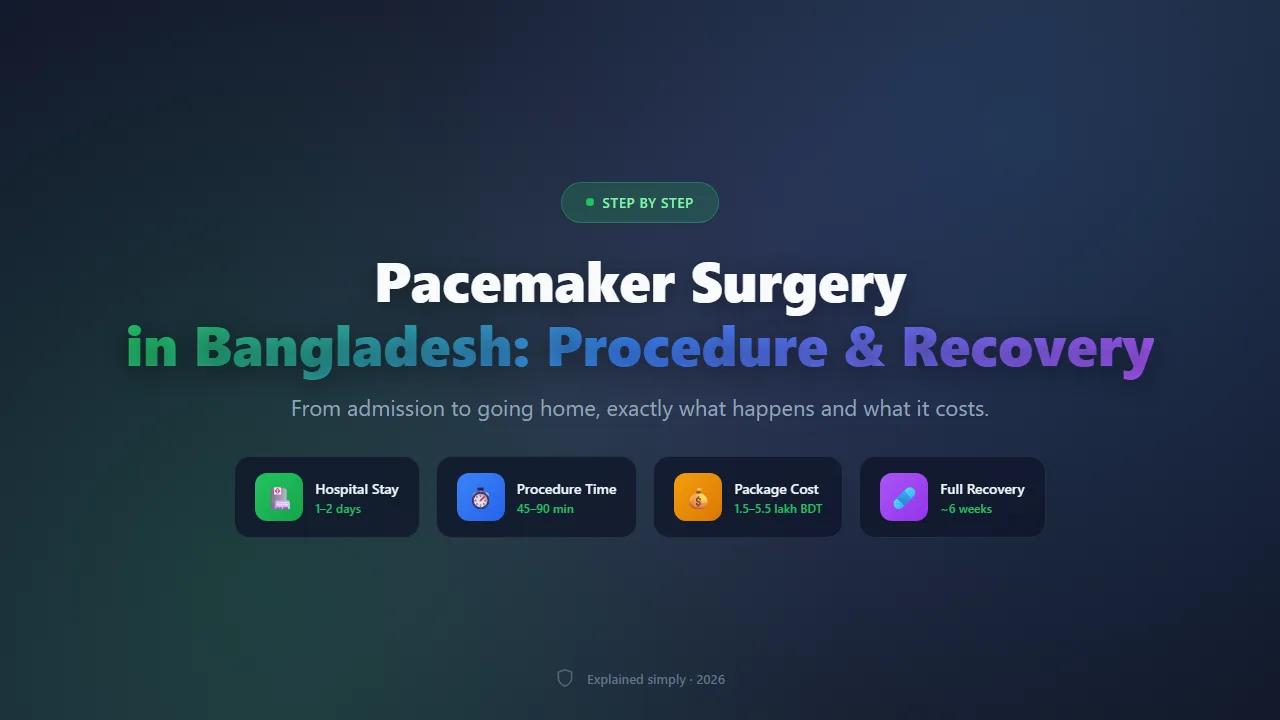
Facing any heart procedure is stressful, and most of that stress comes from not knowing what will happen. This guide walks you through pacemaker implant surgery in Bangladesh step by step: what to do before admission, what happens in the cath lab, what risks exist, and how long recovery really takes. We write it the way we explain it to patients at Rhythm Care Ltd in Dhaka, in plain language.
What Is Pacemaker Implantation?
Pacemaker implantation is a minor surgical procedure to place a small battery-powered device under the skin near your collarbone. Thin wires called leads connect the device to your heart. When your natural heartbeat runs too slow or pauses, the device sends a small electrical pulse to keep the rhythm steady.
The procedure is not open-heart surgery. It does not require opening the chest. Most patients in Dhaka go home the next day.
Before the Surgery: Preparation
Once your cardiologist confirms you need a pacemaker, preparation usually takes one or two days.
Typical pre-surgery steps:
- Blood tests to check kidney function, blood counts, and clotting
- ECG and echocardiogram to map your heart rhythm
- Chest X-ray
- Review of your medicines. Blood thinners and diabetes medicines may need adjusting
- Fasting for about six to eight hours before the procedure
- Shaving and cleaning of the area below the collarbone on the day of surgery
- Signing of consent forms after your doctor explains the procedure and risks
Bring a family member. In most Bangladeshi hospitals you will need an attendant, and it helps to have another pair of ears listening to the instructions.
Step-by-Step: What Happens in the Cath Lab
Here is what actually happens on the day, in order.
Step 1. Local anesthesia and mild sedation. The area below your collarbone is numbed with local anesthetic. You also get light sedation to stay relaxed, but you remain awake. Most patients describe the experience as painless but strange, feeling some pulling and pressure.
Step 2. A small incision. The doctor makes a cut of about 4 to 5 centimeters below the left or right collarbone.
Step 3. Lead placement. The doctor finds a vein under the collarbone and threads the lead or leads through it into the heart chambers. X-ray guidance (fluoroscopy) shows the position on a screen in real time. For a single-chamber device there is one lead. For dual-chamber there are two.
Step 4. Testing the leads. Each lead is tested to make sure it senses your heart’s own signals and paces reliably. This step matters. A well-tested lead is the foundation of years of trouble-free pacing.
Step 5. Placing the device. The doctor creates a small pocket under the skin and connects the leads to the pacemaker. The device slides into the pocket.
Step 6. Closing the incision. The wound is stitched or closed with surgical glue and covered with a dressing. Total time in the lab: roughly 45 to 90 minutes depending on the device type.
Step 7. First device check. Before you leave the lab or shortly after, the device is checked with a wireless programmer to confirm it is working as planned.
After the Surgery: Hospital Stay
Most patients stay one night, sometimes two. During this time:
- Nurses monitor your heart rhythm and wound
- You may have a chest X-ray to confirm lead position
- Pain is usually mild and managed with simple tablets
- Your arm on the implanted side is rested, but gentle finger and wrist movement is encouraged
Before discharge you get a device card with your pacemaker model and settings. Keep this card with you always, including at airports.
Risks: What Could Go Wrong?
Pacemaker implantation is one of the safest cardiac procedures, but honest medicine means naming the risks. Serious complications happen in a small minority of cases.
| Risk | How often | What it means |
|---|---|---|
| Bruising or pocket hematoma | Common but usually mild | Blood collecting under the wound, mostly settles on its own |
| Infection | About 1 to 2 percent | May need antibiotics or, rarely, device removal |
| Lead dislodgement | About 1 to 2 percent | A lead moves and needs repositioning |
| Pneumothorax | Under 1 percent | Air leaks around the lung during vein access, usually resolves |
| Reaction to contrast or anesthesia | Rare | Managed in the hospital setting |
Warning signs after you go home: fever, increasing redness or discharge at the wound, sudden swelling, or dizziness with palpitations. Any of these means call your doctor the same day.
Choosing an experienced electrophysiologist and a hospital that does regular device implants is the single best way to lower these risks.
Recovery Timeline
| Phase | What to expect |
|---|---|
| Days 1 to 7 | Keep the wound clean and dry. Light walking is fine. No lifting with the implanted arm |
| Weeks 2 to 4 | Stitches removed or dissolved. Gradually increase arm and shoulder movement as advised |
| Weeks 4 to 6 | Avoid heavy lifting (nothing over about 5 kg with the implanted arm). Driving is usually allowed after the first check-up if your doctor agrees |
| After 6 weeks | Most normal activities resume, including office work, prayer, cooking, and light exercise |
| 1 month check-up | First full device interrogation to check leads, battery, and settings |
Cost of Pacemaker Surgery in Bangladesh
The total cost has two parts: the device and the procedure. As a rough guide, a single-chamber pacemaker package in Dhaka runs from about BDT 1.5 lakh to 3 lakh, and a dual-chamber package from about BDT 3 lakh to 5.5 lakh. Brand choice moves the number significantly. Medtronic, Abbott, Boston Scientific, and Biotronik all have models available locally. For current, itemized prices, see our page on pacemaker price in Bangladesh. Patients who need protection against dangerous fast rhythms rather than slow rhythm should read about the ICD price in Bangladesh instead, since an ICD is a different device.
Life After Recovery
Once healed, most people forget they have a pacemaker. It works silently in the background. You will attend follow-up visits every six to twelve months for a device check, which takes about 15 minutes. Mobile phones, microwaves, and daily electronics are safe with basic precautions, which we cover in detail in another article on this site.
The main long-term habit is simple: never miss your follow-up appointments, because the battery level and lead function need periodic checking.
FAQ
Is pacemaker surgery painful?
You feel pressure and movement but not pain, because the area is numbed. Mild soreness at the wound site for a few days afterward is normal.
How long does the whole procedure take?
Usually 45 to 90 minutes in the lab. Plan on a half day at the hospital including preparation.
When can I sleep on the operated side?
Wait about four weeks or until your doctor confirms the leads are secure, then sleep however feels comfortable.
Can I do prayer and normal household work after implantation?
Yes. Gentle movement is encouraged early. Avoid pressure or overstretching of the implanted shoulder for the first four to six weeks.
—
Ready to plan your pacemaker implant with clear costs and expert care? Book an appointment at Rhythm Care Ltd, Dhaka today.







Leave a Comment