
![final-logo[1]](https://rhythmcareltd.com/wp-content/uploads/elementor/thumbs/final-logo1-scaled-e1746056972397-scaled-ruqy3bwsz2r7w21yid55zivnvu9pr54am1hccjtohw.webp "final-logo[1]")

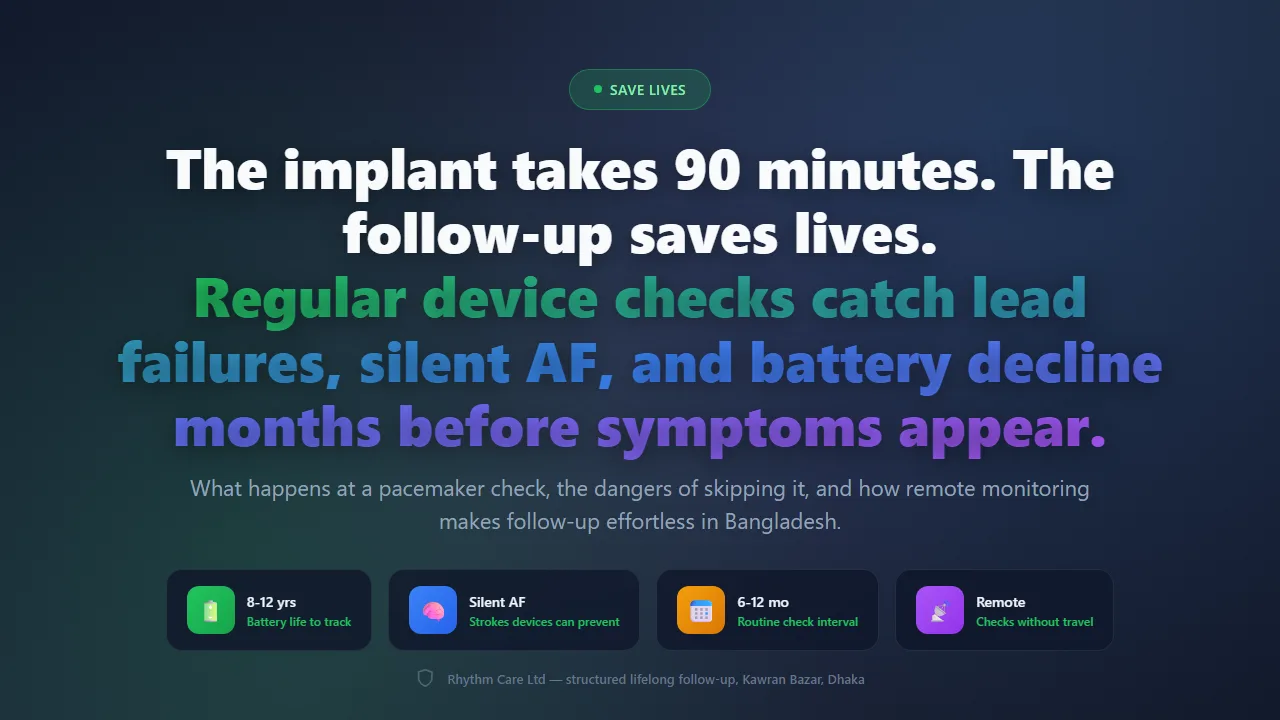
Somewhere in Bangladesh right now, a pacemaker patient is walking around with a lead that quietly stopped working three months ago. The device knows; it has been flagging the problem in its stored data at every check interval. Nobody is reading that data, because in this country the most common pattern of device care is: successful implantation, wound heals, patient feels fine, follow-up forgotten until something dramatic happens years later.
This gap between what devices can tell us and what patients actually hear is one of the most fixable problems in cardiac care here. This article explains what happens during device checks, why skipping them is genuinely dangerous rather than just careless, and how modern remote monitoring has removed most of the old excuses for not coming.
What a pacemaker actually needs after implantation
A pacemaker is a machine with a battery, electrical leads threaded through your veins, and software making thousands of decisions about your heartbeat every day. Machines in continuous service need inspection, and this particular machine sits inside a body where leads move with every breath and scar tissue forms around them over months.
Routine follow-up monitors four things:
Battery status. Batteries deplete gradually over 8 to 12 years, but not always linearly. High pacing demand, lead problems, or component faults can accelerate depletion unpredictably. Regular checks track the decline so replacement gets planned electively instead of discovered urgently.
Lead integrity. Leads can fracture, insulation can wear through, or the screw-in tip can pull away from tissue. These failures are often silent at first. The device compensates by raising its output, burning battery faster and masking the underlying problem, until the compensation fails and you feel dizzy or faint.
Pacing thresholds and sensing. The energy needed to capture the heart changes over time as tissue matures around the leads. Follow-up visits fine-tune device output to the minimum safe level, which extends battery life significantly. A device left on factory settings for years can lose two or three years of battery life compared with an optimized one.
Rhythm events. Modern pacemakers record every arrhythmia they witness. Checks routinely reveal atrial fibrillation the patient never felt, which matters enormously because silent AF causes strokes. Studies show device-detected subclinical AF raises stroke risk several-fold, and catching it means starting anticoagulation before the stroke instead of after.
What actually goes wrong when checks are skipped
The failure patterns we see repeatedly in Dhaka:
- Asymptomatic lead failure discovered too late. A fractured atrial lead may cause no symptoms until the device starts inappropriate tracking, or until ventricular lead issues produce pauses. Detected at routine interrogation, a lead revision is planned and straightforward. Discovered during a collapse, it’s an emergency admission.
- Silent atrial fibrillation going untreated. A dual-chamber pacemaker logs mode switches the patient never noticed. Without follow-up, nobody sees them, nobody starts blood thinners, and the stroke arrives without any cardiac warning.
- Battery end-of-life ambush. Patients who vanish for five years sometimes return only when the device reaches elective replacement indicator and beyond, arriving for urgent generator change with higher infection risk from rushed logistics.
- Inappropriate settings never optimized. Output programmed conservatively at implant and never adjusted wastes battery and, in some cases, promotes the very ventricular dysfunction long-term pacing can cause.
None of these require exotic medicine to prevent. They require that somebody reads the device data periodically. That’s all a check-up is.
How often should checks happen?
Standard schedules look like this:
- First check: within days of implantation, wound review and settings verification.
- First three to six months: one or two checks while thresholds stabilize.
- Stable years: every 6 to 12 months for pacemakers; ICDs typically every 3 to 6 months because shock therapy demands closer surveillance.
- After elective replacement indicator appears: every 1 to 3 months, since depletion accelerates near the end.
- Any time symptoms occur: palpitations, dizziness, fainting, or a delivered ICD shock warrants immediate interrogation regardless of schedule.
With remote monitoring layered on top, in-clinic visits can stretch longer because problems transmit themselves between appointments.
Remote monitoring changes everything
Every modern Abbott, Medtronic, and Boston Scientific device supports remote transmission. A small bedside transmitter (or increasingly, a smartphone app) sends your device’s stored data over mobile networks to the monitoring center automatically. The clinic reviews transmissions on defined schedules and urgently flags anything abnormal: high lead impedance suggesting fracture, arrhythmia episodes, rapid battery decline.
For Bangladeshi patients the practical value is hard to overstate. If you live in Sylhet, Khulna, or a village outside Mymensingh, traveling to Dhaka four times a year for a ten-minute interrogation isn’t realistic, and pretending otherwise just produces skipped checks. Remote monitoring means most routine surveillance happens from home, with travel reserved for procedures and annual hands-on reviews. During the pandemic years this became standard practice worldwide, and it has stayed standard because outcomes improved.
Setup takes minutes at our Kawran Bazar center. Costs vary by manufacturer subscription; ask us for current figures when you visit, and compare that modest annual fee against the cost of a single emergency admission, let alone a stroke.
What a check-up visit involves
If you’ve never had a device interrogation, expect this: you lie down, a wand or pad is placed over the device, and the programmer talks to it wirelessly for ten to fifteen minutes. No needles, no pain. The report covers battery voltage and impedance, lead measurements, threshold trends, percentage of pacing in each chamber, heart rate statistics, and recorded arrhythmias. The specialist then adjusts settings if needed and prints a report for your file.
Bring your device identification card and a list of any symptoms, however minor. “Occasional fluttery feeling at night” often correlates with logged episodes that turn out to be clinically important.
The cost case for follow-up
Device prices in Bangladesh are regulated, which patients can verify in our pacemaker pricing guide, and ICD costs are covered separately here. Those are significant investments: BDT 1,45,000 upward for a pacemaker, several lakh for an ICD. Skipping BDT 1,000-2,000 follow-up checks on a two-lakh-taka device is like buying a bus and never changing its oil. The arithmetic only works if you protect the asset, and unlike a bus, the asset is keeping you alive.
Making follow-up stick
Practical habits that keep device care from slipping:
- Book your next check before leaving each appointment, rather than intending to call later.
- Enroll in remote monitoring at the first opportunity.
- Keep a single folder, physical or phone-based, with your device card, implant report, and last interrogation printout.
- Tell family members your check schedule; in practice relatives often remember better than patients.
- Treat any symptom change as a trigger, not a wait-and-see matter.
How we can help
Rhythm Care Ltd runs structured lifelong follow-up for pacemaker and ICD patients from our Kawran Bazar center, including remote monitoring services covering anywhere in Bangladesh with mobile coverage. We service devices implanted at other hospitals too, so wherever your implant happened, your follow-up can start now. Bring your device card and reports, or call +880 1819-227038 to set up remote transmission. Book an appointment online.
Frequently asked questions
How often should my pacemaker be checked?
Every 6 to 12 months once stable, more frequently after the battery’s elective replacement indicator appears, and immediately whenever new symptoms occur. ICDs need checks every 3 to 6 months.
Can my device be checked without visiting Dhaka?
Yes. Remote monitoring transmits your device data over mobile networks to our center automatically, so most routine surveillance requires no travel at all.
What happens if a device check finds a problem?
It depends on the finding: settings can often be reprogrammed on the spot; lead issues may need a revision procedure; newly detected atrial fibrillation calls for anticoagulation discussion. Finding problems early is precisely the point.
My pacemaker was implanted years ago and I’ve never had a check. Is it too late?
No. Come in with your device card if you have it; even without it, the device can be identified and interrogated. Starting late beats never starting.






Leave a Comment