


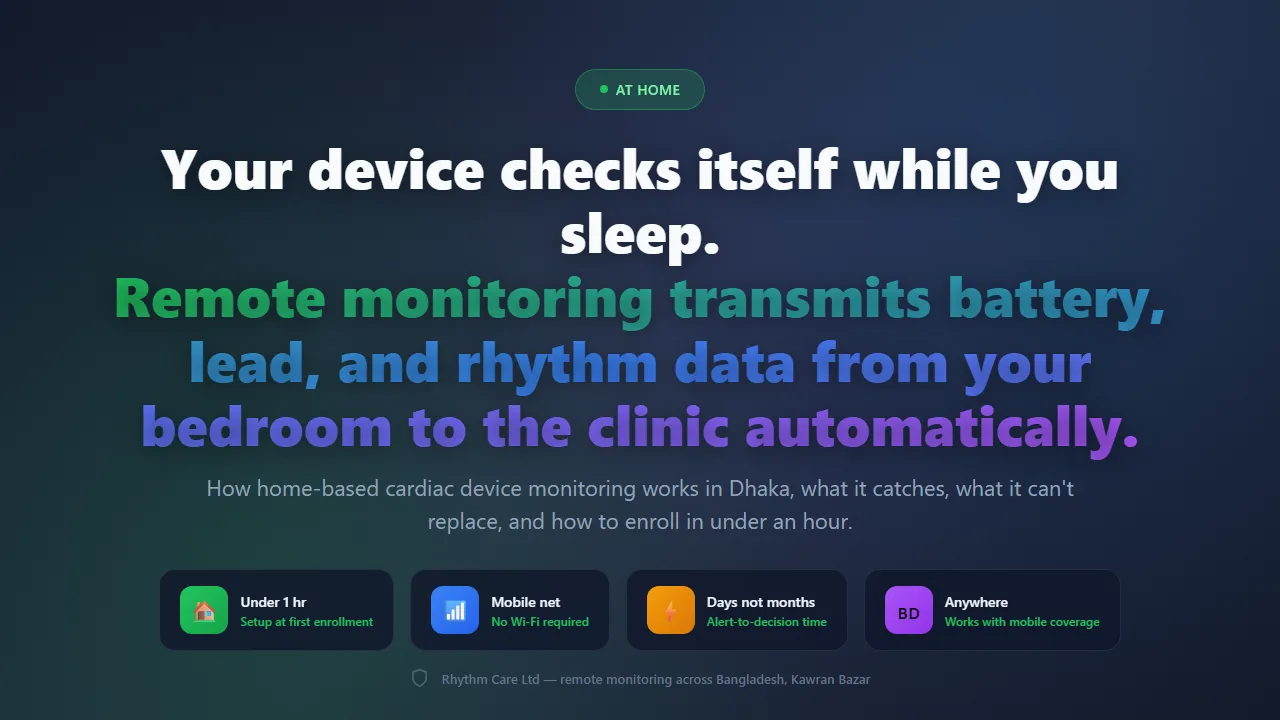
For a pacemaker or ICD patient living in Dhaka traffic, a “quick device check” is never quick. It’s two to four hours of travel, a waiting hall, a ten-minute interrogation, and the return journey, repeated two to four times a year for the rest of your life. For patients outside the capital, multiply accordingly. It’s no mystery why so many device patients in Bangladesh quietly drop out of follow-up.
Remote monitoring removes most of that burden. Your device transmits its stored data over the mobile network to the clinic automatically, from your bedroom, without you doing anything beyond keeping the transmitter plugged in or an app on your phone. This article explains how home-based device checks work, what they can and cannot replace, and how to get set up in Dhaka.
How remote cardiac device monitoring works
Every modern pacemaker, ICD, and loop recorder from Abbott, Medtronic, and Boston Scientific has a built-in radio. The system has three parts:
- Your implanted device continuously records its own status: battery voltage, lead measurements, pacing percentages, and every arrhythmia it witnesses. It stores this data and holds alerts for anything abnormal.
- A transmission device in your home. Depending on your device model, this is either a small bedside transmitter, about the size of a Wi-Fi router, or simply an app on your smartphone that communicates with the implant when you place the phone over it.
- The monitoring clinic. Data arrives over the mobile network or Wi-Fi to a secure server your clinic reviews. Scheduled transmissions go through on a set calendar, typically every one to three months, and any urgent alert triggers an immediate notification to the monitoring team regardless of schedule.
The first transmission is set up once, at the clinic or during a home visit, and after that the loop runs itself. You don’t press buttons or remember dates.
What remote monitoring catches
This is where the technology earns its keep. Between scheduled in-clinic visits, home transmissions routinely detect:
- Lead problems. A rise in lead impedance can signal fracture; a drop can signal insulation breach. These changes appear in transmitted data months before they’d cause symptoms, turning an emergency into a planned procedure.
- Battery anomalies. Rapid unexpected depletion shows up early, leaving ample time to arrange generator replacement electively.
- Silent atrial fibrillation. Devices log AF episodes patients never feel. Remote alerts let the clinic start the anticoagulation conversation immediately, and this matters because device-detected AF carries real stroke risk.
- Delivered or appropriate-inappropriate ICD shocks. If your defibrillator fires at 2 a.m., the monitoring team can know that morning rather than whenever you next happen to visit.
- Worsening heart failure signals. Many devices track thoracic impedance and activity trends that decline before patients notice fluid buildup, allowing early medication adjustment.
Published experience across large device populations shows remote monitoring shortens the time from event to clinical decision from months to days, and trials have associated it with better survival and fewer inappropriate shocks in ICD patients compared with office-only follow-up.
What it cannot replace
Honesty requires the limits too. Remote monitoring is surveillance, not a full examination:
- Wound and pocket checks after implantation need eyes and hands. Infection risk is highest in the first weeks.
- In-clinic interrogation remains necessary periodically, usually annually, because some measurements and reprogramming options are done best in person.
- Threshold testing and reprogramming happen at visits. Remote systems report what the device measured; they don’t optimize settings by themselves.
- Symptom evaluation is yours to report. If you feel palpitations, dizziness, or a shock, call the clinic regardless of what the last transmission said. Data flows one way; your voice still has to travel the other.
The practical formula: remote monitoring between visits, plus an annual or semi-annual in-person check, plus a phone number you actually call when something changes.
Setting it up in Dhaka
The process is straightforward:
- Device compatibility check. Bring your device card or implant report. Any device implanted in the last decade almost certainly supports remote transmission.
- Registration and pairing. At our Kawran Bazar center (or during a home visit if travel is difficult), the transmitter is paired to your device and your first transmission is confirmed received.
- Schedule setting. Your monitoring calendar is configured: routine transmissions plus alert thresholds tuned to your condition.
- Orientation. You learn what the transmitter’s lights mean, what to do during power cuts (the system buffers and resends; nothing is lost), and which situations warrant calling.
- Ongoing review. Our team reviews each transmission and contacts you if anything needs action. Routine reports go into your file for your annual visit.
Total setup time is under an hour. After that, your follow-up burden drops to occasional in-person visits, and patients anywhere with mobile coverage, Cumilla, Rangpur, Chattogram, a village in Noakhali, get the same surveillance as someone living in Dhanmondi.
What it costs
Remote monitoring carries an annual connectivity and service subscription set by the device manufacturer, typically modest compared to any other part of device care. In-clinic interrogation visits in Dhaka run roughly BDT 1,000 to 3,000. Compare either figure with a single emergency admission for a device-related event, which starts around BDT 50,000 and climbs quickly, or with the lifetime cost of a stroke from untreated silent AF, which can exceed several lakh taka. The subscription is the cheapest insurance attached to your device.
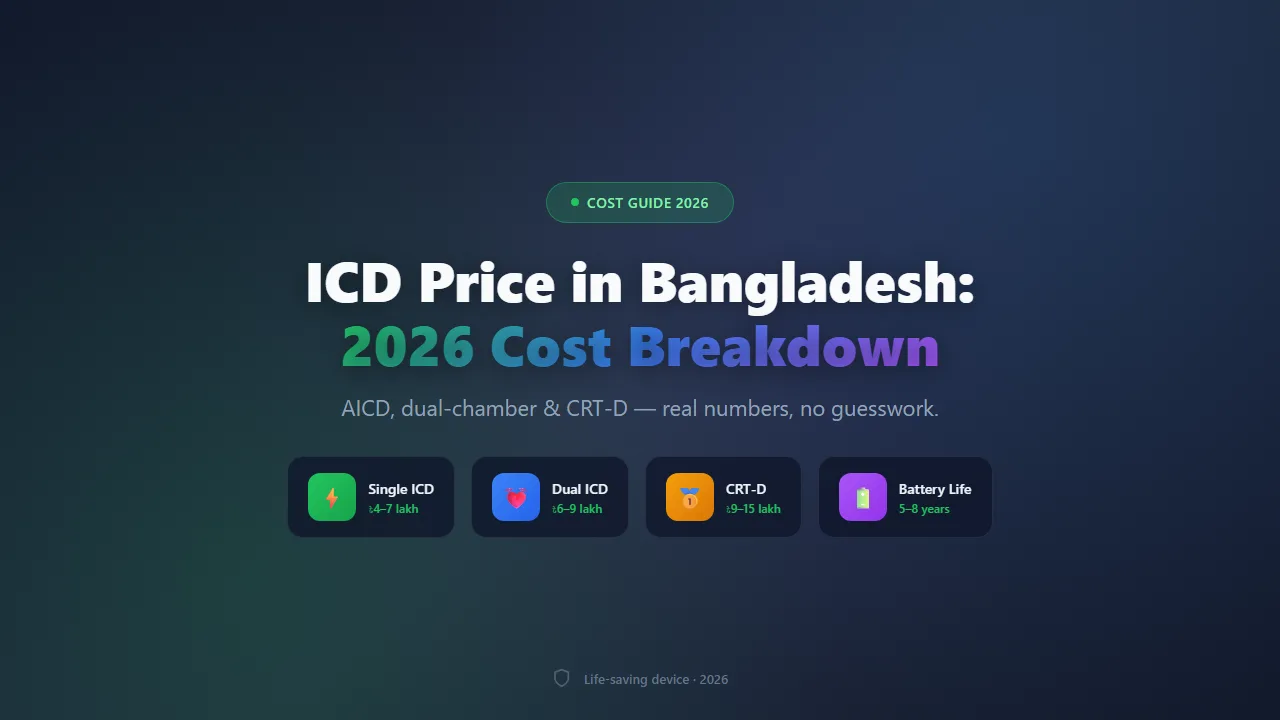
For context on the device investment itself, our guides to pacemaker prices in Bangladesh and ICD prices explain the regulated pricing structure.
Common questions from patients and families
Will the transmitter disturb my sleep or emit radiation?
No. The transmission is brief, low-power, and typically scheduled during the night or when you place the phone over the device. It is far weaker than a mobile phone call.
What happens during a power cut?
The transmitter buffers data and sends it when power returns. Missed transmissions generate an alert on the clinic side, so gaps get noticed and followed up.
I had my pacemaker implanted at another hospital. Can I still enroll?
Yes. Remote monitoring depends on the device, not the implanting hospital. Bring your card and reports; we can enroll devices implanted anywhere and take over follow-up.
Is my medical data secure?
Transmissions go through encrypted manufacturer servers to authorized clinical staff only. The systems are the same ones used by device clinics worldwide.
Who benefits most
Remote monitoring matters for every device patient, but especially for:
- ICD patients, where shock events and lead surveillance demand tight follow-up.
- Anyone living outside Dhaka or planning to relocate to a district town.
- Elderly patients for whom travel itself is a health risk.
- Patients with heart failure, where device data trends enable early medication changes.
- Anyone with a history of atrial fibrillation or stroke, where silent AF detection directly changes treatment.
How we can help
Rhythm Care Ltd provides remote cardiac device monitoring from our Kawran Bazar center for patients across Bangladesh, alongside full in-clinic interrogation, device programming, and lifelong rhythm care. We enroll devices implanted at any hospital and coordinate with your treating cardiologist so reports reach the right hands. Setup takes less than an hour and your first transmission is confirmed before you leave. Book an appointment or call +880 1819-227038 to enroll.
Frequently asked questions
Can my pacemaker really be checked from home?
Yes. Modern devices transmit battery, lead, and rhythm data automatically over mobile networks to the clinic. Most routine checks no longer require a visit.
How often does my device transmit data?
Typically every one to three months on schedule, plus immediately whenever an alert-level event occurs, such as a lead abnormality or an ICD shock.
Do I still need to visit the clinic at all?
Yes, usually once or twice a year for hands-on interrogation, wound checks when relevant, and settings optimization. Remote monitoring covers the gaps between visits.
What if I don’t have Wi-Fi at home?
Bedside transmitters work over mobile networks, so Wi-Fi isn’t required. If you have mobile coverage, you can be monitored.



Leave a Comment