
![final-logo[1]](https://rhythmcareltd.com/wp-content/uploads/elementor/thumbs/final-logo1-scaled-e1746056972397-scaled-ruqy3bwsz2r7w21yid55zivnvu9pr54am1hccjtohw.webp "final-logo[1]")

For decades, finding out what your heart was doing meant travelling to a hospital, waiting in a queue, and hoping your symptoms cooperated during the ten seconds of the test. If they did not, you went home with no answers and another appointment slip.
That model is changing. Remote cardiac monitoring lets the test come to you: a device in your pocket records the exact moment your heart misbehaves, and a specialist reviews the tracing from wherever they are. In Dhaka traffic terms, that difference is measured in hours and thousands of taka.
What Remote Cardiac Monitoring Means
Remote cardiac monitoring covers any approach where your heart rhythm is recorded outside the clinic and transmitted to medical staff for review. The family includes Holter monitors worn for a day or more, patch recorders worn for weeks, implantable loop recorders placed under the skin for years, and pocket ECG devices used on demand.
The common thread is simple: the heart gets caught doing whatever it actually does during real life, not during an anxious ten minutes on a hospital bed. Rhythm problems are famously intermittent. A monitor embedded in daily routine sees far more than any clinic visit ever will.
How a Pocket ECG Works, Step by Step
A pocket ECG is the lightest entry into remote monitoring. The workflow looks like this:
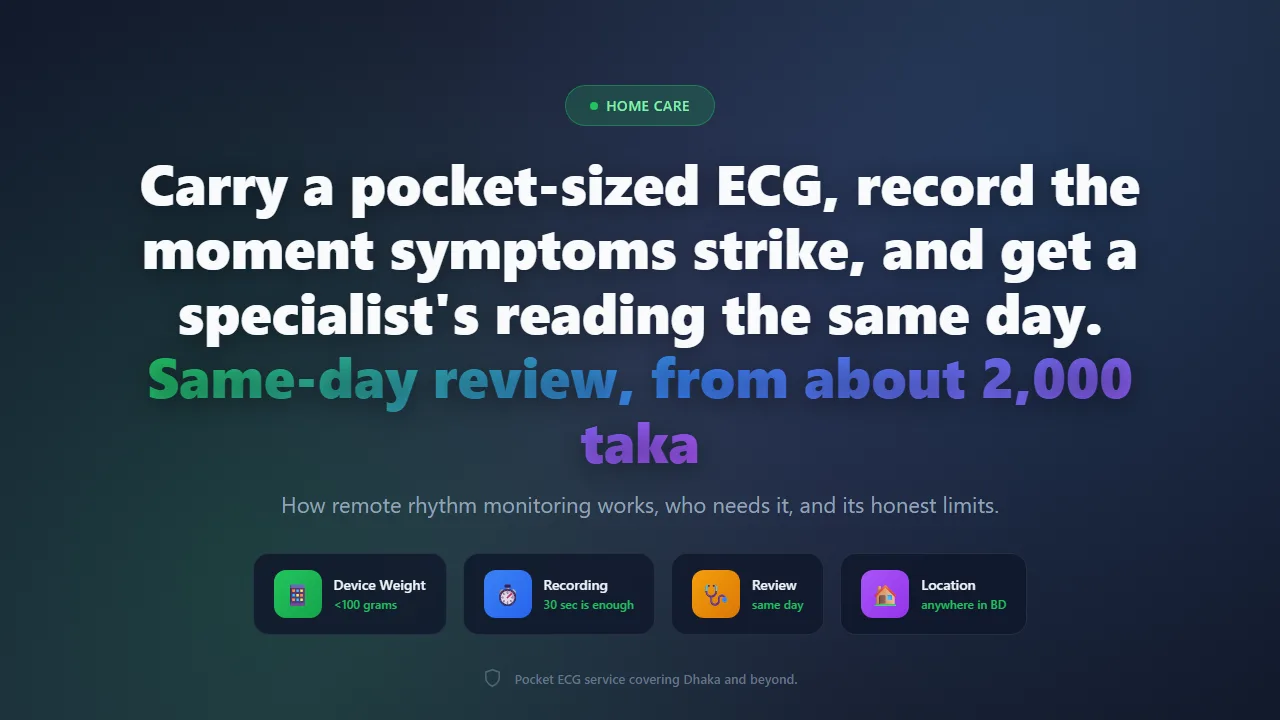
- You carry the device like a phone or key fob. Modern units weigh less than 100 grams.
- When symptoms start, you place your thumbs or fingers on the metal sensors, or attach a small wireless chest patch, depending on the model.
- The device records 30 seconds to several minutes of single-lead ECG, enough to identify AFib, SVT, pauses, and frequent extra beats.
- The recording transmits through Bluetooth to a phone app or directly over mobile data.
- A cardiologist reviews the strip, often within hours, and reports back with an interpretation and next steps.
- Repeat as needed. Every episode becomes evidence instead of a fading memory.
At Rhythm Care Ltd in Dhaka, this cycle typically completes within the same day, starting from around 2,000 taka per reviewed recording. Compare that to repeated round trips across the city for tests that keep missing the moment.
Why Capturing the Episode Changes Everything
Cardiology has a saying: no rhythm strip, no diagnosis. Symptoms described from memory (“it raced, I think, for maybe five minutes”) cannot distinguish anxiety-driven sinus tachycardia from SVT, or extra beats from AFib. Those conditions lead to completely different treatments, from nothing at all to anticoagulants to ablation.
A recorded episode ends the guessing:
- Regular fast rhythm at 180 appearing and stopping abruptly suggests SVT, potentially curable with one ablation procedure.
- Irregularly irregular rhythm without clear P waves confirms atrial fibrillation and triggers stroke-risk assessment and blood thinner decisions. See our AFib guide.
- Normal sinus rhythm recorded exactly when symptoms peaked is equally valuable. It redirects investigation toward thyroid, anaemia, anxiety, or reflux rather than months of pointless cardiology visits.
- Long pauses during dizzy spells point toward conduction disease, where the pacemaker pathway eventually enters the discussion.
One honest recording saves more time and money than three rounds of blind testing.
Who Benefits Most From Home Monitoring
People with occasional palpitations. Episodes once or twice weekly are nearly invisible to short clinic tests but trivially easy for a carried device.
Known AFib patients tracking treatment. Intermittent recordings confirm whether medicines are holding the rhythm, catching silent recurrences before they cause strokes.
Post-procedure follow-up. After ablation or device implantation, periodic home checks extend specialist supervision without hospital trips, which matters enormously for patients outside Dhaka.
Elderly patients and their families. Adult children abroad increasingly arrange monitoring for parents in Sylhet or Khulna; a recording can be shared with our cardiologists by phone within minutes of an episode.
Anxious hearts stuck in reassurance loops. When every flutter triggers panic, having a tool that proves “the rhythm right now is normal” breaks the cycle better than verbal reassurance ever does.
Pocket ECG vs Hospital Tests: An Honest Comparison
Home devices have limits worth stating plainly. A single-lead strip cannot assess everything a 12-lead ECG can, such as subtle signs of blocked arteries, chamber enlargement, or inherited conduction patterns. It also records only when used, so it misses silent problems you never feel.
The realistic picture:
| Situation | Best tool |
|---|---|
| Chest pain suspected angina | Clinic 12-lead ECG + further testing |
| Occasional palpitations | Pocket ECG during episodes |
| Daily symptoms | 24–48 hr Holter |
| AFib treatment follow-up | Intermittent pocket recordings |
| Unexplained fainting | Continuous auto-detect monitoring |
| Routine screening | Clinic ECG + checkup |
Remote monitoring complements clinic care; it does not replace emergency services. Chest pain with sweating still means going to a hospital immediately, not recording yourself at home.
Getting Started From Anywhere in Bangladesh
The practical steps are simpler than most people expect:
- Book a consultation through our appointment page, in person or by phone.
- Describe your symptom pattern honestly: frequency, duration, what episodes feel like.
- Receive the device with a five-minute demonstration of use.
- Record during real episodes over the agreed period.
- Get specialist-reviewed results and a clear plan: treat, investigate further, or genuinely reassure.
Patients outside Dhaka can coordinate recordings remotely and share tracings digitally, so geography no longer decides who gets expert rhythm care.
Common Questions Before People Start
Will I feel anything during recording?
Nothing. Finger-sensor devices read tiny electrical signals through the skin. No shock, no sensation.
What if my symptoms stop before I reach the device?
Record anyway within a few minutes; useful information often remains. And note the exact time so doctors can correlate with any auto-detected data.
Can I use it while travelling?
Yes. That portability is the entire point. Record on the bus, at the office, at 2 am.
Is the data private?
Tracings go only to your treating team through secure channels, same as any medical report.
How many recordings do I need?
Until diagnosis. Some patients get their answer from the first episode; others need two or three weeks. Either way, cost stays modest compared with serial clinic visits.
Does insurance cover it?
Coverage varies by policy. Our staff provide documentation patients routinely submit to insurers.
Frequently Asked Questions
Is a pocket ECG accurate enough to diagnose AFib?
Yes. Single-lead strips detect AFib with accuracy comparable to standard ECGs, which is why international guidelines accept them for screening and detection.
Can it detect a heart attack?
Not reliably. It can show concerning changes that prompt urgent care, but suspected heart attack always needs full hospital evaluation.
Do smartwatches replace these devices?
They help with screening, but watch sensors miss episodes, produce false alarms, and generate traces many cardiologists find harder to interpret. A dedicated reviewed service adds specialist judgement on top of raw data.
What happens if something dangerous is found?
Your reviewing cardiologist contacts you directly and directs you to appropriate urgent care. That safety net is part of proper remote monitoring.
Your Heart, Watched Without Leaving Home
Rhythm Care Ltd brings remote cardiac monitoring to patients across Dhaka and beyond, pairing simple devices with genuine specialist review. No queues, no missed episodes, no vague advice.
Start through our appointment page or call us. Tell us what your heart has been doing. We will give you the tools to show us.
*Prices reflect current Dhaka rates and may change; confirmation at booking.*





Leave a Comment