
![final-logo[1]](https://rhythmcareltd.com/wp-content/uploads/elementor/thumbs/final-logo1-scaled-e1746056972397-scaled-ruqy3bwsz2r7w21yid55zivnvu9pr54am1hccjtohw.webp "final-logo[1]")

Your doctor says your heart rhythm needs watching, and suddenly you are hearing three names that sound like siblings: Holter monitor, event recorder, pocket ECG. They all record your heartbeat. The difference is when they record, for how long, and how likely each one is to actually catch what is happening inside your chest.
Pick the wrong one and you can spend good money on a test that misses the problem entirely. This guide helps you have that conversation with your cardiologist with the right questions in hand.
Why One Ten-Second ECG Is Rarely Enough
A standard clinic ECG records about ten seconds of heart activity. Your heart beats roughly 100,000 times a day. If an abnormal rhythm shows up twice a month and lasts a few minutes, the chance of it appearing during one random ten-second window is close to zero.
That is why the most common story in cardiology goes like this: “I feel my heart racing at night sometimes, but every ECG I’ve done is normal.” The test was fine. The timing was impossible.
Extended monitoring solves this by recording across hours, days, or weeks until the rhythm misbehaves on camera.
The Holter Monitor: Continuous Recording
How it works
A Holter is a small box, roughly the size of an old phone, connected to four or five sticky electrodes on your chest. It records every single beat without interruption. You wear it for 24 hours, 48 hours, or up to 7 days with newer patch models. You keep a simple diary noting when symptoms happen.
What it catches well
Frequent palpitations, pauses, fast rhythms that occur daily, and silent irregularities you did not even feel. Because nothing is missed during wear time, the Holter gives the fullest picture of any ambulatory test.
Where it falls short
If your episodes come once a week or once a month, even 48 hours of recording will probably miss them. Also, chest wires and electrodes make showering awkward, and some patients feel self-conscious wearing visible leads to work.
Cost in Dhaka
Typically 3,000 to 8,000 taka depending on duration and facility.
The Event Recorder: Record Only When Symptoms Strike
How it works
An event recorder does the opposite of a Holter. Instead of recording everything, it waits. When you feel a symptom, you press a button and it saves the rhythm from just before and just after the press. Some models are worn continuously; others are carried in a pocket and pressed against the chest during an episode. Wear time stretches to 30 days or more.
What it catches well
Rare but clearly symptomatic episodes: monthly palpitations, dizzy spells, fainting attacks. Because it stays on duty for weeks, its capture rate for infrequent symptoms is far higher than any short Holter.
Where it falls short
It depends on you pressing the button in time. If a dangerous episode knocks you out before you can react, an older manual recorder misses it. Newer auto-detect models partly solve this by saving abnormal rhythms automatically.
Cost in Dhaka
Event monitoring is less widely available than Holter testing. Expect roughly 5,000 to 12,000 taka where offered, varying with rental duration.
The Pocket ECG: Small Device, Fast Answers
How it works
A pocket ECG is a compact handheld device, usually working through finger sensors or a small wireless chest patch. You carry it normally, and when symptoms appear you place your thumbs on the sensors or attach the patch for a 30-second to few-minute recording. Modern versions pair with a phone app and send the tracing straight to the cardiology team, who review it and reply, often within hours.
At Rhythm Care Ltd in Dhaka, we use pocket ECG devices precisely because they fit real life: no visible wires at the office, no interrupted showers, and a specialist reading each episode as it happens rather than days later.
What it catches well
Symptom-rhythm correlation. The single most useful question in palpitation care is “what was the heart doing exactly when you felt that?” A pocket ECG answers it directly, episode after episode.
Where it falls short
It records only when used, so it cannot find silent problems you never feel. For unexplained fainting or suspected dangerous pauses during sleep, continuous monitoring is safer.
Cost in Dhaka
From around 2,000 taka per reviewed recording, which keeps repeat testing realistic.
Side-by-Side Comparison
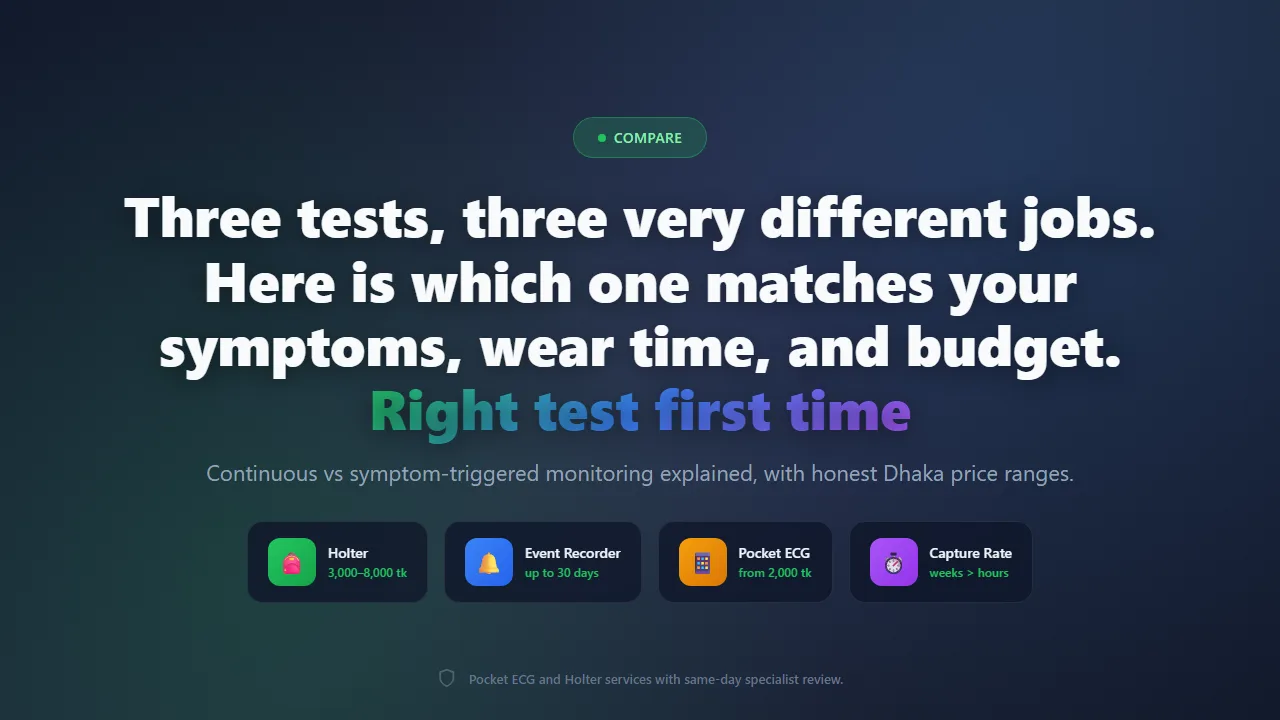
| Feature | Holter | Event Recorder | Pocket ECG |
|---|---|---|---|
| Recording style | Continuous | On symptom | On symptom |
| Typical wear time | 24–72 hrs | Up to 30 days | Days to weeks |
| Catches silent problems | Yes | Auto models only | No |
| Best for | Daily symptoms | Rare symptoms | Occasional clear symptoms |
| Shower friendly | No | Varies | Yes (handheld) |
| Dhaka price range | 3,000–8,000 tk | 5,000–12,000 tk | from 2,000 tk |
Matching the Test to Your Situation
Palpitations several times a week? Start with a 24 or 48 hour Holter. Odds of catching an episode are decent, and you get a complete dataset.
Episodes once or twice a month? Skip short Holters. Ask for an event recorder or carry a pocket ECG and record during actual episodes over two to four weeks.
One clear symptom pattern you can reproduce? Like fluttering whenever you drink coffee or lie on your left side. A pocket ECG recorded during the next episode answers everything cheaply.
Fainting spells or dizziness with no warning? These worry cardiologists most because they can reflect serious pauses or fast rhythms. You need continuous auto-detect monitoring, and if results stay unclear, further electrophysiology workup. In select high-risk cases, protective implantable devices enter the discussion; our pages on pacemaker price in Bangladesh and ICD price in Bangladesh explain those options honestly.
Known AFib follow-up? Intermittent pocket ECG checks are excellent for tracking whether treatment is keeping your rhythm controlled, without repeating full Holters constantly.
Common Mistakes People Make
- Stopping at one normal Holter. If symptoms persist after a clean 48 hours, the answer is longer or patient-triggered monitoring, not reassurance.
- Wearing a Holter like a hospital patient. Sit still and the test loses value. Do your normal day, climb your stairs, take your usual stress. Record real life.
- Skipping the diary. An episode on the tracing with no note about what you felt makes interpretation harder.
- Recording too late. With a pocket device, start within a minute or two of symptoms starting. Rhythms often settle quickly.
- Ignoring benign findings. Occasional skipped beats in an otherwise normal heart rarely need anything beyond follow-up. Panic over every ectopic beat causes more suffering than the beats themselves.
Frequently Asked Questions
Can I sleep with a Holter monitor?
Yes, and you should. Night-time rhythm data is valuable. Just secure the wires comfortably.
Will the electrodes irritate my skin?
Mild redness is common after a couple of days. Tell the technician if you have sensitive skin; hypoallergenic pads exist.
Is a pocket ECG as accurate as a hospital ECG?
For rhythm diagnosis, yes. A good single-lead strip is enough to identify AFib, SVT, pauses, and frequent ectopics. A full 12-lead still adds detail about other conditions, so both have their place.
How soon do I get results?
Holter reports usually take one to two days after return. Pocket ECG recordings reviewed through our service often reach you the same day.
Do I need these tests forever?
No. Once a diagnosis is made and treatment started, monitoring becomes occasional check-ins rather than a permanent routine.
Get Matched to the Right Test
Choosing between these tests is exactly the kind of decision a rhythm specialist makes every day, and getting it right saves you money and months of anxiety.
Rhythm Care Ltd offers Holter monitoring and pocket ECG services in Dhaka with direct cardiologist review. Book through our appointment page and bring a list of when your symptoms happen. We will recommend the shortest path to an answer.
*Prices reflect typical Dhaka ranges as of 2026 and vary by facility.*





Leave a Comment