
![final-logo[1]](https://rhythmcareltd.com/wp-content/uploads/elementor/thumbs/final-logo1-scaled-e1746056972397-scaled-ruqy3bwsz2r7w21yid55zivnvu9pr54am1hccjtohw.webp "final-logo[1]")

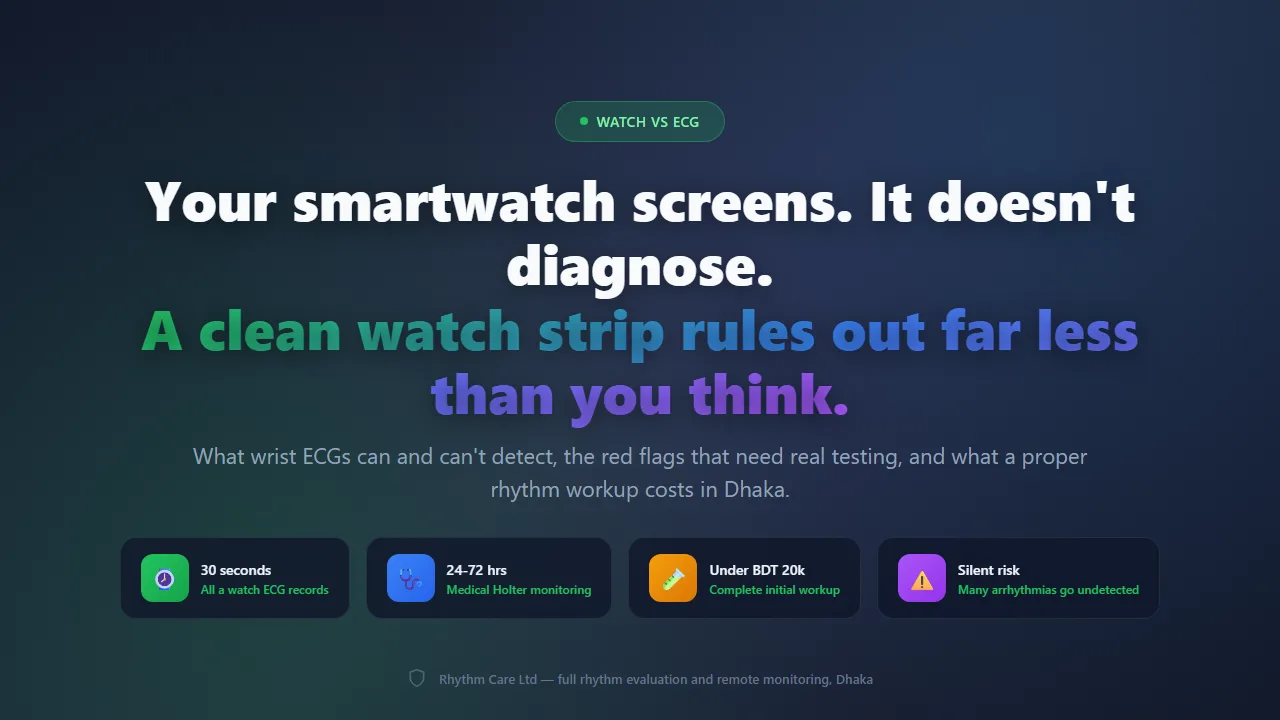
Smartwatches have quietly become the most common heart monitors in Bangladesh. Millions of people now glance at a wrist reading that says their heart rate is 72, or get an irregular rhythm notification, and draw conclusions from it. Some of those conclusions are reasonable. Others are genuinely dangerous in both directions: people reassured by a clean strip who have serious disease, and people terrified by a false alarm who need nothing at all.
A smartwatch ECG is a real ECG. It records one electrical lead, usually between two fingers and the watch back, for about thirty seconds. That’s useful information. But it’s a screening snapshot, not a diagnostic workup, and knowing the difference could matter to your health.
What your smartwatch actually measures
When you take a smartwatch ECG, here’s what happens under the hood:
- It captures a single-lead tracing, roughly equivalent to lead I on a hospital ECG.
- It records for 30 seconds, sometimes less if your fingers aren’t making good contact.
- Its algorithm looks mainly for atrial fibrillation, because AF is common, dangerous when untreated, and has a distinctive irregular pattern that software can spot reasonably well.
What it cannot do with any reliability:
- Detect most other arrhythmias. Atrial flutter with regular conduction, sick sinus syndrome, certain ventricular arrhythmias, and conduction blocks often look normal or ambiguous to a single-lead consumer algorithm.
- Catch arrhythmias that don’t happen during the recording. Paroxysmal atrial fibrillation comes and goes. A clean 30-second strip on Tuesday tells you nothing about what happened last Saturday night.
- Measure intervals precisely enough for treatment decisions. The PR interval, QT interval, and QRS width that cardiologists use to diagnose conduction disease require a 12-lead recording with electrodes placed in standard positions.
- Rule anything out. This is the big one. A “normal” result means the watch didn’t see AF in that half-minute, nothing more.
The false reassurance problem
The scenario we see regularly at our Dhaka clinic goes like this: a man in his fifties has had episodes of dizziness and palpitations for months. His watch says sinus rhythm every time he checks, so he assumes he’s fine. What he doesn’t know is that his episodes involve intermittent high-grade AV block, which his watch either misses entirely or classifies as a low heart rate. He eventually lands in an emergency room after a fainting episode that could have been caught six months earlier.
The opposite happens too. Healthy people get irregular-rhythm notifications from premature atrial or ventricular beats, which are common and often benign, then spend weeks anxious and sleepless, which ironically worsens palpitations. Both problems come from treating a screening tool as a diagnosis.
There’s also a measurement caveat specific to wrist devices. Optical heart rate sensors read blood flow, not electrical activity. During fast arrhythmias like atrial flutter or SVT, the optical sensor can misread badly, showing 60 bpm when the heart is actually running at 150. Only an electrical recording settles it.
When a wrist alert deserves real follow-up
Take these seriously and get evaluated promptly:
- An irregular rhythm notification confirmed by more than one recording on different days.
- Watch-detected heart rates persistently above 120 or below 45 while you’re awake and resting, especially with symptoms.
- Any syncopal episode, meaning actual fainting or near-fainting, regardless of what the watch showed. Fainting plus any arrhythmia history needs proper cardiac evaluation, full stop.
- Symptoms during activity: unusual breathlessness, chest discomfort, exercise intolerance that came on without explanation.
And get a medical evaluation regardless of your watch if you have risk factors: diabetes, hypertension, prior stroke, family history of sudden death, or you’re over 60 with any palpitations at all.
What a proper medical rhythm workup includes
Medical testing uses different tools calibrated for different questions:
12-lead ECG. Ten minutes in a clinic. Gives precise intervals, shows conduction block, chamber enlargement, old infarcts, pre-excitation. Cheap, fast, and still the foundation of everything.
Holter monitor. A portable recorder worn for 24 to 72 hours that captures every beat continuously. This is how you catch frequent ectopy, intermittent block, and rate-control problems.
Event monitor or patch. Worn for 7 to 30 days for symptoms that come sporadically. Patient-triggered recorders capture the exact moment of symptoms, which is what actually links symptom to rhythm.
Implantable loop recorder. A small device placed under the skin that monitors for up to three years. Reserved for unexplained syncope where external monitoring came up empty. This catches the rare but lethal causes of fainting that nothing else will find.
Echo and lab work. Often needed alongside, because rhythm problems frequently travel with structural heart disease, thyroid dysfunction, or electrolyte issues.
The point isn’t that medical testing is fancier. It’s that each test answers a question your watch was never designed to ask.
Costs in Dhaka
This is where good news matters: proper evaluation costs far less than most people expect, especially compared to the price of missing something serious.
A 12-lead ECG runs around BDT 300 to 800 at clinics in Dhaka. Holter monitoring typically costs BDT 3,000 to 6,000 depending on duration. Extended patch monitoring ranges BDT 8,000 to 15,000. Even the full initial workup, including consultation and echo, generally stays under BDT 15,000 to 20,000 total. Compare that with treating a stroke caused by undiagnosed AF, which can cost several lakh taka and leave permanent disability.
If testing does reveal a condition needing a device, pacemaker prices in Bangladesh are government-regulated, starting around BDT 1,45,000, and ICD pricing is similarly transparent. The expensive part of rhythm care is not finding the problem.
Using your smartwatch wisely
We’re not anti-smartwatch. Used correctly, these devices save lives; population studies have shown watch-based AF screening detects previously unknown atrial fibrillation in a meaningful share of older users. Keep wearing it. Just apply three rules:
- Treat alerts as prompts for medical evaluation, never as all-clear signals. Absence of alerts proves even less than presence of them.
- Bring the data to your doctor. Export the PDF tracings from the app. Cardiologists can read a single-lead strip themselves and extract far more than the app’s binary verdict.
- Match the tool to the question. Screening for AF? Watch is reasonable. Diagnosing dizziness, fainting, or palpitations? You need continuous monitored recording and clinical judgment.
How we can help
Rhythm Care Ltd provides full rhythm evaluation in Dhaka: 12-lead ECG, Holter and extended monitoring, device implantation coordination, and lifelong follow-up with remote monitoring from our Kawran Bazar center. If your watch has flagged something, or worse, if your symptoms say something while your watch stays silent, bring both the tracings and your story to us. Book an appointment or call +880 1819-227038.
Frequently asked questions
Can a smartwatch detect all heart rhythm problems?
No. Consumer watches screen mainly for atrial fibrillation using a single 30-second lead. Many significant arrhythmias, including conduction block and some dangerous ventricular rhythms, go undetected.
My watch said normal but I still feel palpitations. Should I worry?
Yes, symptoms always outrank the device. Palpitations, dizziness, or fainting deserve a medical evaluation with proper monitoring regardless of watch readings.
How long do I need to wear a Holter monitor?
Typically 24 to 72 hours. If symptoms are infrequent, an event monitor or patch worn for one to four weeks gives better yield.
Are smartwatch ECG results accurate for AF detection?
Reasonably accurate for detecting AF in people over 50 when used properly, though false positives occur. But accuracy for one condition is not a general health certificate.





Leave a Comment