
![final-logo[1]](https://rhythmcareltd.com/wp-content/uploads/elementor/thumbs/final-logo1-scaled-e1746056972397-scaled-ruqy3bwsz2r7w21yid55zivnvu9pr54am1hccjtohw.webp "final-logo[1]")


Every year in Bangladesh, seemingly healthy people collapse and die without warning: a 45-year-old businessman at his desk, a young footballer on the field, a grandmother who seemed fine the evening before. Many of these deaths come from sudden cardiac arrest, an electrical failure of the heart that kills within minutes.
Here is what most families do not realise: for a large group of patients, this outcome is largely preventable. A device called an ICD (implantable cardioverter defibrillator) detects a lethal rhythm and corrects it within seconds, automatically, day and night. The question is knowing whether you or someone you love belongs in that high-risk group.
This article explains who qualifies for an ICD, which risk factors demand attention, and how to get assessed in Dhaka.
What an ICD Actually Does
An ICD is a device slightly larger than a matchbox, implanted under the skin near the collarbone with wires leading into the heart. It monitors every single heartbeat. If the heart slips into ventricular tachycardia or fibrillation, rhythms too fast to pump blood, the ICD either paces the rhythm back to normal or delivers an internal electric shock. Treatment arrives in under 20 seconds, faster than any ambulance could possibly reach you.
It cannot prevent the arrhythmia from starting. What it prevents is death from it.
Clear-Cut Reasons You Need an ICD
International guidelines are unambiguous about several groups. If you fall into any category below, an ICD discussion with an electrophysiologist is warranted.
1. You survived a cardiac arrest
If your heart has stopped once due to ventricular fibrillation or sustained ventricular tachycardia, and doctors found no reversible cause (such as an acute blockage fixed by stenting, or a drug side effect), an ICD is standard care worldwide. Second arrests kill far more often than first ones; the device exists precisely for this situation.
2. Your heart pumps weakly
The key number is the ejection fraction (EF), measured on a routine echocardiogram. EF describes what percentage of blood leaves the heart with each beat. Normal sits between 55 and 70 percent.
Guidelines support an ICD when:
- EF is 35 percent or lower due to previous heart attack or dilated cardiomyopathy, and
- You have been on proper heart-failure medicines for at least three months, and
- You are expected to survive meaningfully longer than a year with reasonable quality of life.
That three-month medicine trial matters. Good medical therapy sometimes lifts EF above the threshold, removing the need for a device. Get re-tested before deciding either way.
3. You carry an inherited rhythm condition
Several genetic conditions raise arrest risk dramatically, often in people who look and feel completely healthy:
| Condition | Typical clue | Notes |
|---|---|---|
| Hypertrophic cardiomyopathy | Thickened heart wall on echo | Common cause of collapse in young athletes |
| Long QT syndrome | Long QT interval on ECG | May run silently through families |
| Brugada syndrome | Characteristic ECG pattern | More visible during fever |
| Arrhythmogenic right ventricular cardiomyopathy | Palpitations, family history | Progressive scarring of heart muscle |
ICD decisions here depend on the specific condition plus added risk markers such as fainting episodes, extensive family history of sudden death, or documented dangerous rhythms.
4. Syncope with danger signs
Unexplained fainting carries extra weight when combined with a weak heart, a scarred heart, or a family history of sudden death. Fainting is never something to dismiss in a cardiac patient; it can be the rehearsal for an arrest.
Risk Factors That Deserve a Rhythm Assessment Now
Even outside the clear-cut categories, certain situations justify a cardiology review:
- Prior heart attack with scarring, even years ago. Scar tissue generates abnormal circuits.
- Heart failure symptoms: breathlessness lying flat, swollen ankles, waking up gasping.
- Family history: any relative who died suddenly before age 50, or unexplained road or drowning accidents (which can hide arrhythmic deaths).
- Recurring palpitations with blackout or near-blackout.
- Diabetes with silent heart disease, common in Bangladesh, where nerve damage masks typical chest pain.
Two cheap tests screen most of this: a 12-lead ECG and an echocardiogram. Together they cost a few thousand taka in Dhaka and take less than an hour. If results raise questions, a Holter monitor (24 to 48 hour rhythm recording) or an electrophysiology study follows.
Who Does NOT Need an ICD
Honest guidance includes saying who should stay away from implantation:
- Patients with EF above 35 to 40 percent and no history of arrest or inherited disease
- People whose dangerous rhythms came from a fixable cause: acute ischemia corrected by stent, electrolyte imbalance, or an arrhythmia curable by ablation
- Patients whose overall health makes a year of meaningful benefit unlikely; the device protects a life, it cannot improve a terminal illness
If a doctor recommends an ICD without showing you your EF measurement or explaining the reason, ask. And equally, if you were told years ago that your EF was low and never re-checked after medication changes, get re-measured. Device decisions follow current numbers, not old ones.
What Happens After Implantation
The procedure itself takes one to two hours under local anesthesia with light sedation. Most patients go home next morning. Recovery rules for the first month protect the wound and leads: no heavy lifting, no driving until cleared, no raising the implant arm above the shoulder.
Afterwards, life returns close to normal, with a few permanent adjustments covered in our guide to living with an ICD, including driving restrictions, phone placement, and what an actual shock feels like.
Cost of ICD Implantation in Dhaka
Device cost drives nearly everything. As broad ranges including procedure and hospital charges:
| Device type | Approximate package (BDT) |
|---|---|
| Single-chamber ICD | 5 to 7 lakh taka |
| Dual-chamber ICD | 7 to 9 lakh taka |
| CRT-D (three-lead system for heart failure) | 10 to 14+ lakh taka |
Brand choice (Medtronic, Abbott, Boston Scientific, Biotronik), battery longevity, and MRI compatibility shift prices. For current figures see ICD price in Bangladesh and compare against pacemaker price in Bangladesh if your case involves slow rhythms as well.
Many families spread payments across device selection and admission separately; ask hospitals for itemized written estimates so nothing surprises you later.
Frequently Asked Questions
My EF is 30% but I feel completely fine. Do I really need a device?
Feeling fine does not lower arrhythmia risk; scarred and weak hearts can arrest without warning symptoms. Guidelines base ICD advice on measured EF plus diagnosis, not on how you feel. Discuss it seriously.
Is the shock painful?
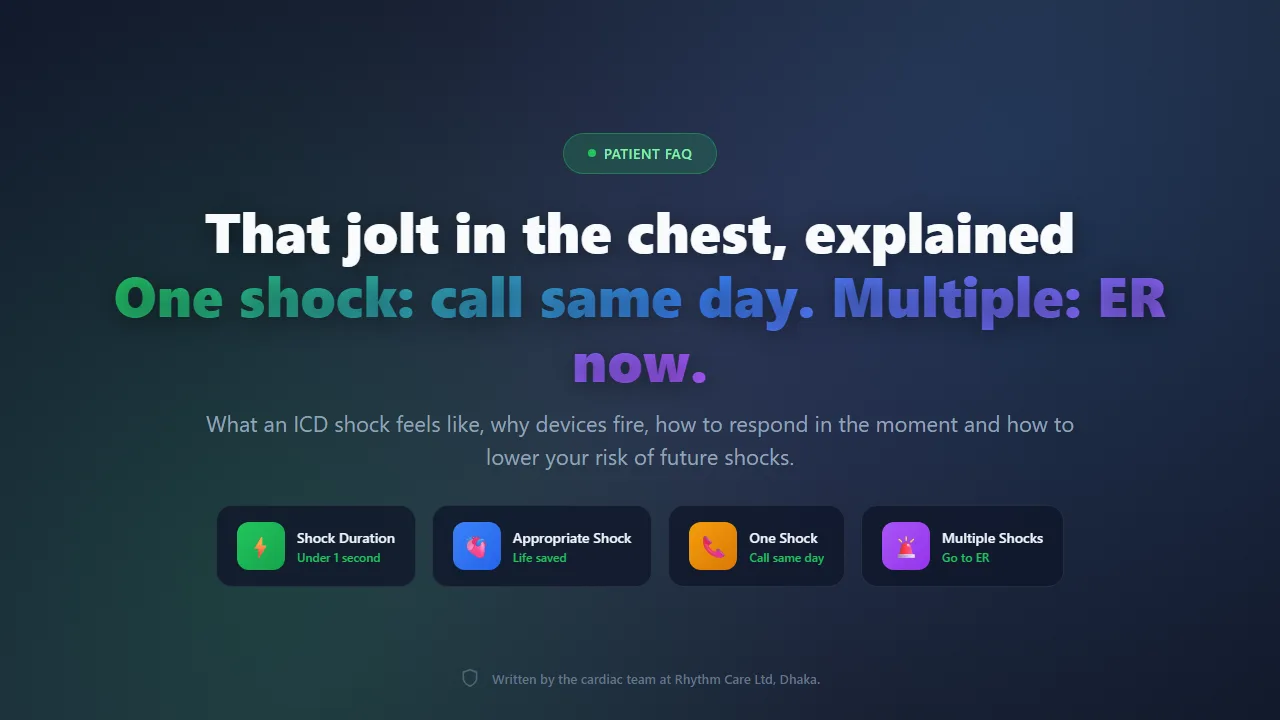
Patients describe it as a hard thump or kick in the chest, startling but brief. Most implanted patients receive few shocks over years, and each one means the device did its job.
How long does an ICD last?
Typically 5 to 8 years before generator replacement, a smaller procedure than the original implant.
Can I get an ICD if I already have a pacemaker?
Often yes, though it usually means replacing the pacemaker with an ICD that includes pacing function. Your electrophysiologist will plan this properly.
Find Out Where You Stand
Bring your old ECGs, echo reports, and discharge summaries to Rhythm Care Ltd in Dhaka. Within one visit we can tell you whether an ICD is recommended, unnecessary, or worth re-testing after medication. Book your assessment at /appointment/.





Leave a Comment