
![final-logo[1]](https://rhythmcareltd.com/wp-content/uploads/elementor/thumbs/final-logo1-scaled-e1746056972397-scaled-ruqy3bwsz2r7w21yid55zivnvu9pr54am1hccjtohw.webp "final-logo[1]")

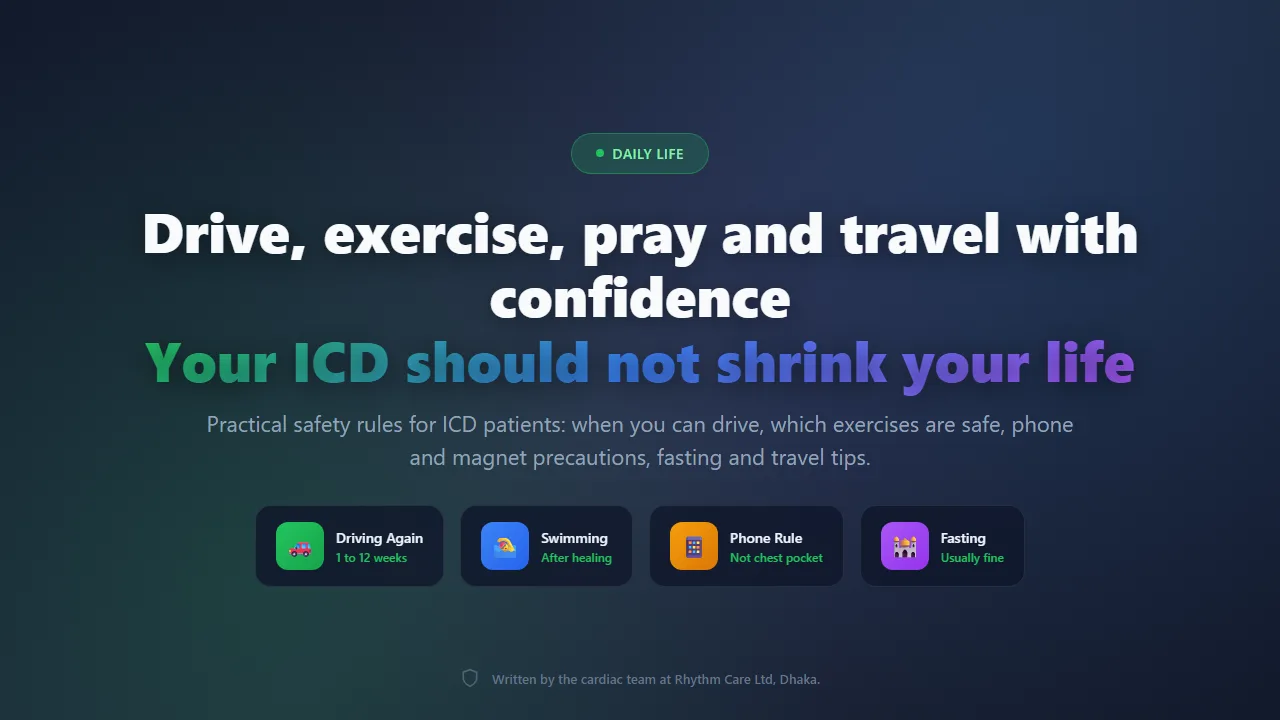
The first weeks after an ICD implant bring a stream of practical questions. Can I drive to my shop? Will my phone break the device? Can I still pray in the mosque, carry my grandchild, use the microwave? Patients at our Dhaka clinic ask these daily, and they deserve straight answers rather than vague reassurance.
The good news first: an ICD changes far less of your life than you fear. People with ICDs work, travel, marry, exercise, and grow old. What follows is a practical guide to daily life with a defibrillator, covering driving, exercise, electronics, prayers, medical care, and travel.
Driving: Rules That Actually Apply
Driving is the area where ICD rules differ most from ordinary life.
After implantation: Expect a pause of 1 to 2 weeks if the ICD was placed preventively (no arrest yet). If it was implanted after an actual cardiac arrest or ventricular arrhythmia, the restriction stretches to 2 to 3 months, because doctors want proof the device and your rhythm have settled. Your own electrophysiologist sets your exact date; follow that, not internet forums.
Ongoing rules:
- If you receive a shock while driving, pull over as soon as safely possible and do not continue until reviewed.
- Long solo highway drives are better avoided until you know how stable your rhythm is.
- Professional driving licences (bus, truck, ride-sharing) face restrictions; discuss honestly during follow-up.
For most private drivers in Dhaka, life resumes normally after the initial clearance period. Traffic stress is real, but the device protects you through it.
Exercise: Yes, With Sensible Limits
An ICD is not a reason to stop moving. Regular moderate exercise strengthens the heart and lowers arrhythmia risk over time.
First 4 weeks (healing phase):
- Walking only, building gradually from 10 minutes twice daily.
- No lifting over 2 to 3 kg with the implant-side arm.
- No raising that arm above shoulder height.
From week 5 onward:
- Brisk walking, cycling on level ground, treadmill, and swimming are all fine once the wound has fully healed.
- Aim for intensity where you can still hold a conversation.
- Warm up and cool down for 5 minutes each; abrupt sprint starts can provoke rhythms in vulnerable hearts.
What to avoid or limit:
| Activity | Verdict |
|---|---|
| Gym weightlifting | Light to moderate weights OK; heavy maximal lifts discouraged |
| Contact sports (football, kabaddi, boxing) | Avoid; direct hits can damage the device |
| Shooting-range sports | Discouraged; recoil sits near the device |
| Golf, badminton, cricket batting | Fine after healing |
| Swimming | Fine once wound healed; no diving boards |
| Sauna / very hot baths | Short exposure fine; prolonged heat not advised |
One useful safety habit for gym-goers: exercise with a partner who knows you have an ICD and knows your doctor’s number.
Electronics, Phones and Household Devices
This section calms the most common worry. Modern ICDs are well shielded, and everyday gadgets cause no harm at normal distances:
- Mobile phones: Talk normally. Just avoid carrying a switched-on phone in the breast pocket directly over the device; keep it in a trouser pocket or the opposite side. Keep phones at least 15 cm from the implant while charging.
- Microwave ovens, TVs, computers, refrigerators: Completely safe.
- Induction cooktops and speakers: Keep at arm’s length while operating; strong magnetic coils sit inside.
- Metal detectors and security arches: Walk through without lingering, show your device card, and request a hand search if preferred. Airport handheld wands should not be held over the device; tell the officer.
- Power generators and large motors: Stay about half a metre back while they run.
Prayers, Fasting and Religious Life
Patients ask about these more than anything else, so let us be direct:
- Salah: After the incision heals (about 4 weeks), full sujood and normal prayer posture are fine. During the first month, pray sitting or use support as comfort requires.
- Fasting in Ramadan: Most ICD patients fast without issue since the device runs independently of food intake. Confirm with your cardiologist regarding your other heart medicines’ timing.
- Umrah and Hajj: Permitted. Carry your device card, a doctor’s letter, and extra medicines. Saudi immigration sees ICD cards routinely.
Medical and Dental Care
- MRI scans: Many newer ICDs are MRI-conditional, meaning scans are possible under proper protocols. Always tell the imaging centre you have an ICD before booking.
- Dental work and minor surgery: Fine. Mention the device; electrocautery tools occasionally need repositioning away from the chest.
- TENS machines and physiotherapy devices: Tell your physiotherapist; some settings need adjusting.
- Other doctors: Every new physician should know your device history. The wallet card does this job; never leave home without it.
Travel Tips
Flying is safe with an ICD. Before travelling:
- Carry your device card and a recent device-check report.
- Pack medicines in hand luggage with prescriptions.
- Ask your clinic for the nearest ICD-following centre at your destination in case of shocks abroad.
- On long flights, walk the aisle hourly and stay hydrated to avoid clots and dehydration-triggered rhythms.
Work, Sleep and Everyday Routines
Beyond driving and exercise, patients ask about the ordinary machinery of daily life:
- Office work: Desk jobs resume around week two. Jobs involving heavy lifting, overhead work, or industrial electrical fields need individual review; discuss honestly rather than hiding duties.
- Sleep: Any position is fine once healed. Some devices log sleep quality automatically, which sometimes surprises patients reviewing their reports.
- Bathing: Showers from day three with wound protection; tub baths wait until the incision fully closes.
- Household chores: Light cooking and washing are fine early; sweeping, mopping with force, or carrying gas cylinders wait out the first month.
- Intimacy: Resumes whenever comfort allows after healing; the heart rate rise involved is no different from climbing stairs.
If any routine leaves you unusually tired or causes palpitations, note it and mention it at your next check. Adjustments are normal, not setbacks.
When To Call Your Doctor
Contact us promptly in these situations:
- Any shock from the device (call the same day if you feel otherwise well; go to emergency care immediately for multiple shocks)
- Fever, wound redness, swelling, or discharge
- Dizziness, fainting, or palpitations
- The sensation that your device site has become unusually thin over the generator
Routine device checks happen every 3 to 6 months initially, then every 6 to 12 months. These take minutes and confirm battery and lead health.
Frequently Asked Questions
Can I use a mobile phone normally?
Yes. Only avoid keeping a powered-on phone pressed against the device for long periods, such as in the same breast pocket.
Will the ICD stop me from working?
Almost never, except jobs involving heavy electrical fields or professional driving, which need individual review.
How will I know the device fired a shock?
Most patients feel a distinct thump or kick in the chest; some lose consciousness briefly during the rhythm and wake up sore. Either way, report it.
Can I hug my children and grandchildren?
Absolutely. The device sits under skin and padding; normal affection harms nothing.
Live Fully, Stay Protected
An ICD is there so you can stop worrying, not start. For device checks, adjustments, or any concern after implantation, visit Rhythm Care Ltd in Dhaka. Book a review at /appointment/.






Leave a Comment