
![final-logo[1]](https://rhythmcareltd.com/wp-content/uploads/elementor/thumbs/final-logo1-scaled-e1746056972397-scaled-ruqy3bwsz2r7w21yid55zivnvu9pr54am1hccjtohw.webp "final-logo[1]")

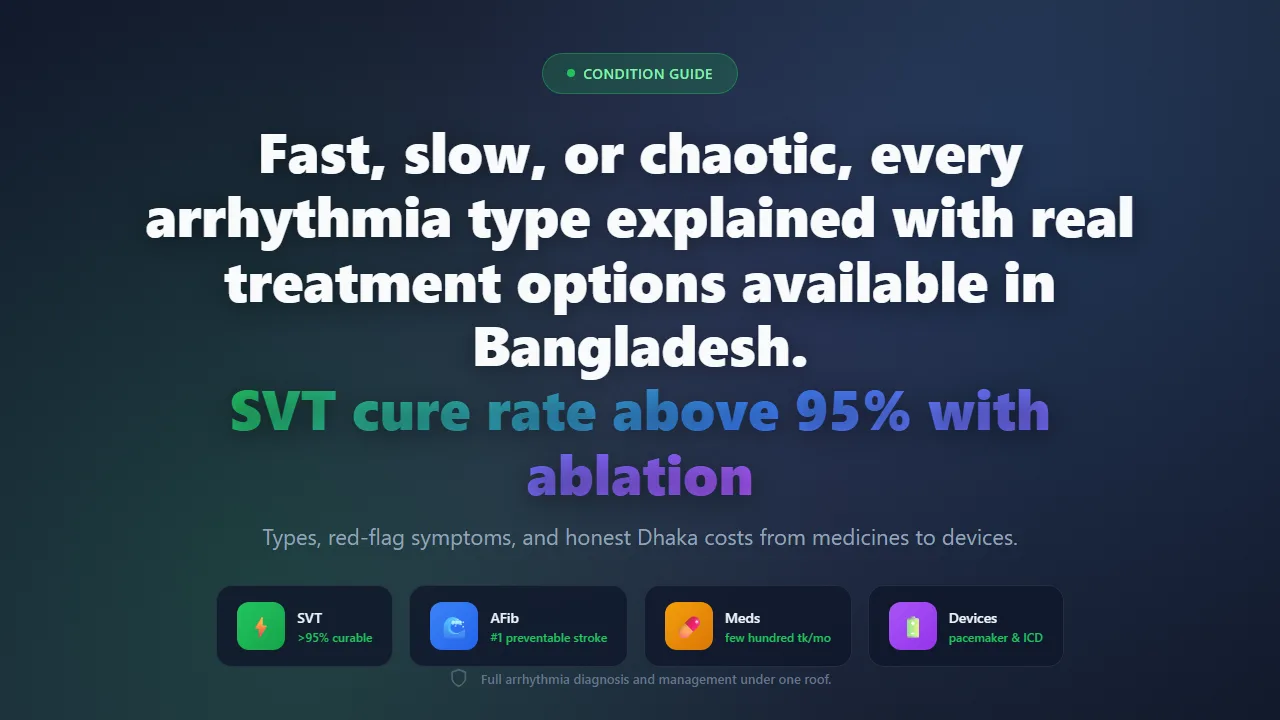
Somewhere between 1 and 2 percent of adults in Bangladesh live with a heart rhythm disorder, and most of them do not know it. Some feel nothing at all. Others have spent years being told their fluttering is “just gas” or “just tension.” Arrhythmia is one of the most under-diagnosed conditions in the country, partly because the test that finds it has to catch the moment it happens.
This article explains what arrhythmia actually means, the main types you should know by name, the symptoms worth taking seriously, and what treatment realistically looks like here in Dhaka.
What Is an Arrhythmia?
Your heart beats because of electrical impulses fired from a natural pacemaker, spreading through the chambers in a precise sequence. An arrhythmia is any deviation from that sequence: too fast, too slow, too early, or chaotically irregular.
Two broad families exist. Tachyarrhythmias make the heart beat too fast. Bradyarrhythmias make it beat too slowly or pause. Within each family, the specific chamber involved and the exact pattern determine how dangerous the problem is and how it gets treated.
One clarification that saves patients a lot of fear: having an arrhythmia does not mean your heart is weak. Many rhythm disorders occur in structurally normal hearts. The electricity misbehaves even when the pump itself is strong.
The Main Types You Should Know
Atrial fibrillation (AFib)
The most common serious arrhythmia worldwide and a major cause of stroke. The upper chambers quiver instead of contracting, blood stagnates in a small pocket where clots form, and one of those clots can travel to the brain. AFib becomes more common with age, high blood pressure, diabetes, obesity, thyroid disease, and sleep apnoea. We cover it fully in our AFib and stroke risk article.
Supraventricular tachycardia (SVT)
Sudden racing, usually 150 to 220 beats per minute, starting and stopping abruptly. Common in young adults, more frequent in women. Uncomfortable but rarely dangerous, and highly curable through catheter ablation.
Ventricular tachycardia (VT)
A fast rhythm arising from the lower chambers. This one is potentially life-threatening, particularly when the heart muscle has prior damage from infarction or cardiomyopathy. Sustained VT needs urgent specialist care.
Bradycardia and heart block
The heart idles below 50, or electrical signals from atria to ventricles get delayed or blocked entirely. Causes include age-related conduction system disease, certain medicines like beta blockers, and hypothyroidism. Symptomatic bradycardia is treated with a pacemaker.
Ectopic beats and non-sustained runs
Extra beats from atria or ventricles, sometimes in short bursts. Usually benign in normal hearts; frequent ventricular ectopics warrant an echo to confirm pumping strength stays intact.
Long QT and inherited channel disorders
Rare genetic conditions that predispose to dangerous rhythms, sometimes triggered by specific medicines. Relevant when there is a family history of sudden unexplained death under 50.
Symptoms: From Ignore-It to Emergency Room
Arrhythmia symptoms range across a spectrum:
Mild and often benign: occasional skipped beats, single thuds, brief flutters lasting seconds.
Worth investigating: repeated palpitation episodes, sustained fast rates, fatigue that exercise does not explain, breathlessness on ordinary activity.
Urgent: fainting or near-fainting, chest pain with palpitations, breathlessness at rest or waking at night gasping, confusion or weakness suggesting poor blood flow, and any racing above 150 that persists despite rest.
The cruel part of this condition is intermittency. A patient can have three clean ECGs and still carry AFib that strikes twice monthly. Diagnosis depends on capturing the rhythm, which is why extended monitoring matters so much. Our comparison of Holter monitors, event recorders, and pocket ECGs explains how each closes that gap.
How Diagnosis Works in Dhaka
A proper evaluation follows this sequence:
- History and pulse examination, including family history of sudden death.
- Resting 12-lead ECG, cheap and fast, catching many baseline abnormalities. Details in our ECG guide.
- Blood tests: thyroid, electrolytes including potassium and magnesium, haemoglobin, kidney function.
- Echocardiogram to assess structure and pumping strength.
- Extended rhythm monitoring matched to symptom frequency.
- In selected cases, electrophysiology study, where thin catheters map the electrical circuits inside the heart directly.
Treatment Options Available in Bangladesh
Lifestyle and trigger management
Before medicines come basics: treating thyroid problems, correcting anaemia and electrolyte deficits, cutting caffeine and nicotine, managing sleep apnoea, moderating alcohol, controlling blood pressure and diabetes. These alone resolve a meaningful share of cases, especially ectopic-driven palpitations and mild sinus tachycardia.
Medicines
Beta blockers (metoprolol, bisoprolol) slow rates and dampen ectopics. Calcium channel blockers serve similar roles. Antiarrhythmic drugs such as amiodarone or flecainide suppress specific rhythms but need specialist supervision, since they carry their own risks. For AFib, anticoagulation (blood thinners such as apixaban or warfarin) prevents stroke and is arguably more important than rhythm control itself.
Medicine costs in Bangladesh are manageable for most families; generic metoprolol costs a few hundred taka monthly, while newer anticoagulants run roughly 2,000 to 4,500 taka per month depending on brand.
Catheter ablation
A day-care procedure where catheters threaded through a vein map and cauterise the faulty circuit causing SVT, many AFibs, or VT. Success rates exceed 95 percent for typical SVT, effectively curing it. Availability in Dhaka is growing, with costs typically in the 3 to 6 lakh taka range depending on hospital and complexity.
Pacemakers
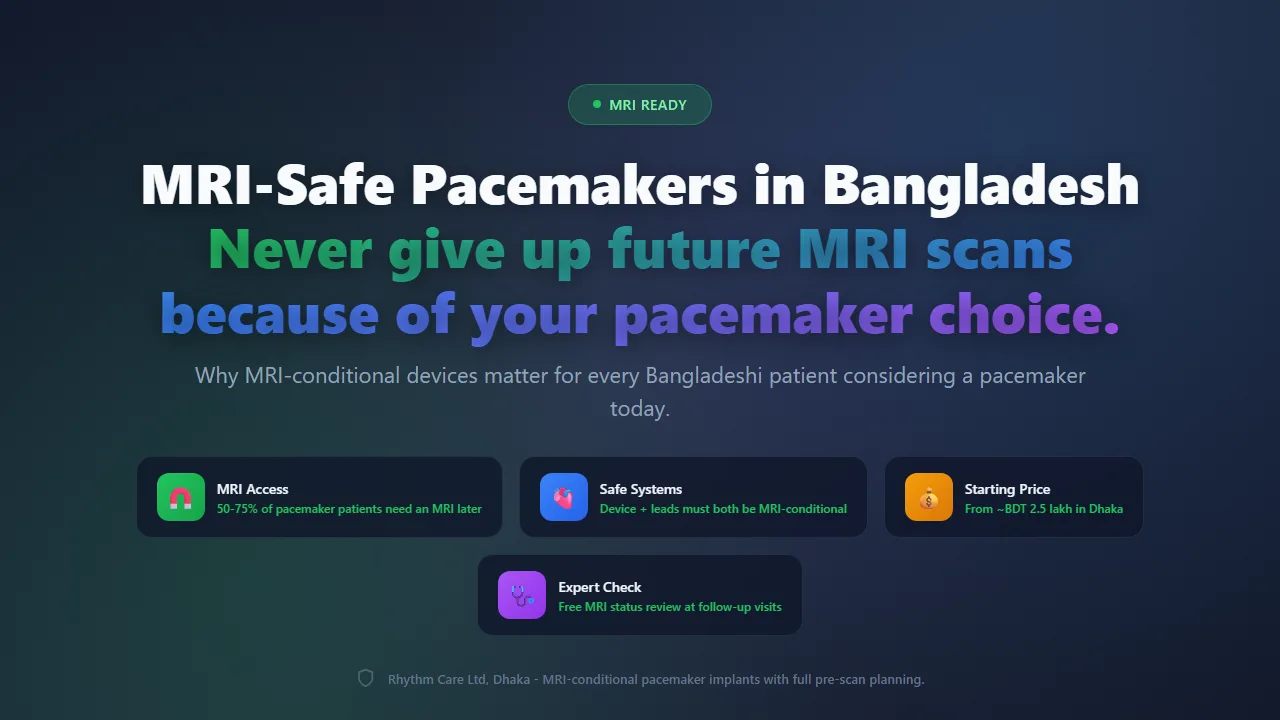
For bradycardia and heart block, a pacemaker takes over pacing duties. Single-chamber devices cost less than dual-chamber; leadless options cost more. Full breakdown of device types, brands, and realistic total costs in our pacemaker price guide for Bangladesh.
ICDs (implantable cardioverter defibrillators)
For survivors of dangerous VT or those at high risk of sudden cardiac arrest, an ICD monitors continuously and delivers a corrective shock within seconds. These devices save documented lives. Costs run higher than pacemakers; see our transparent ICD price in Bangladesh page before making decisions.
Living Well With an Arrhythmia
A diagnosis is not a sentence to fragility. Most people with treated arrhythmias walk, work, travel, and climb stairs normally. Practical advice:
- Take medicines at fixed times; rhythm drugs punish irregular dosing.
- Keep follow-up appointments even when feeling perfect. Silent recurrence is real, especially in AFib.
- Learn your own warning pattern and act early rather than waiting out bad episodes.
- Carry a copy of your latest ECG when travelling.
- Tell close family what to do if you ever faint: check breathing, call for help, no shaking or water splashing.
Frequently Asked Questions
Can arrhythmia go away on its own?
Some do. Ectopic burden often fades with lifestyle change. Childhood SVT occasionally stops recurring. AFib, however, tends to persist and progress without treatment, so it deserves active management.
Is every irregular heartbeat AFib?
No. Extra beats also create irregularity. Distinguishing them requires a recording, not guesswork.
Are arrhythmias hereditary?
Some are. A parent or sibling with sudden death before 50, or known inherited rhythm disease, means relatives should be screened.
What is the success rate of ablation?
For typical SVT, over 95 percent permanent cure. For AFib, 60 to 80 percent freedom from recurrence, sometimes requiring a second procedure.
Do I need to give up tea?
Probably not all of it. One or two cups usually stay fine. It is the fourth cup plus energy drink combination that tips sensitive hearts.
Get Your Rhythm Answered Properly
Rhythm Care Ltd exists for exactly these questions. We diagnose and manage the full range of arrhythmias in Dhaka, from harmless extra beats to complex cases needing device therapy, with clear explanations and honest cost guidance at every step.
Book your consultation via our appointment page. Bring whatever recordings or old reports you have. The right answer starts with the right tracing.
*General information only; treatment decisions require individual assessment.*






Leave a Comment