
![final-logo[1]](https://rhythmcareltd.com/wp-content/uploads/elementor/thumbs/final-logo1-scaled-e1746056972397-scaled-ruqy3bwsz2r7w21yid55zivnvu9pr54am1hccjtohw.webp "final-logo[1]")

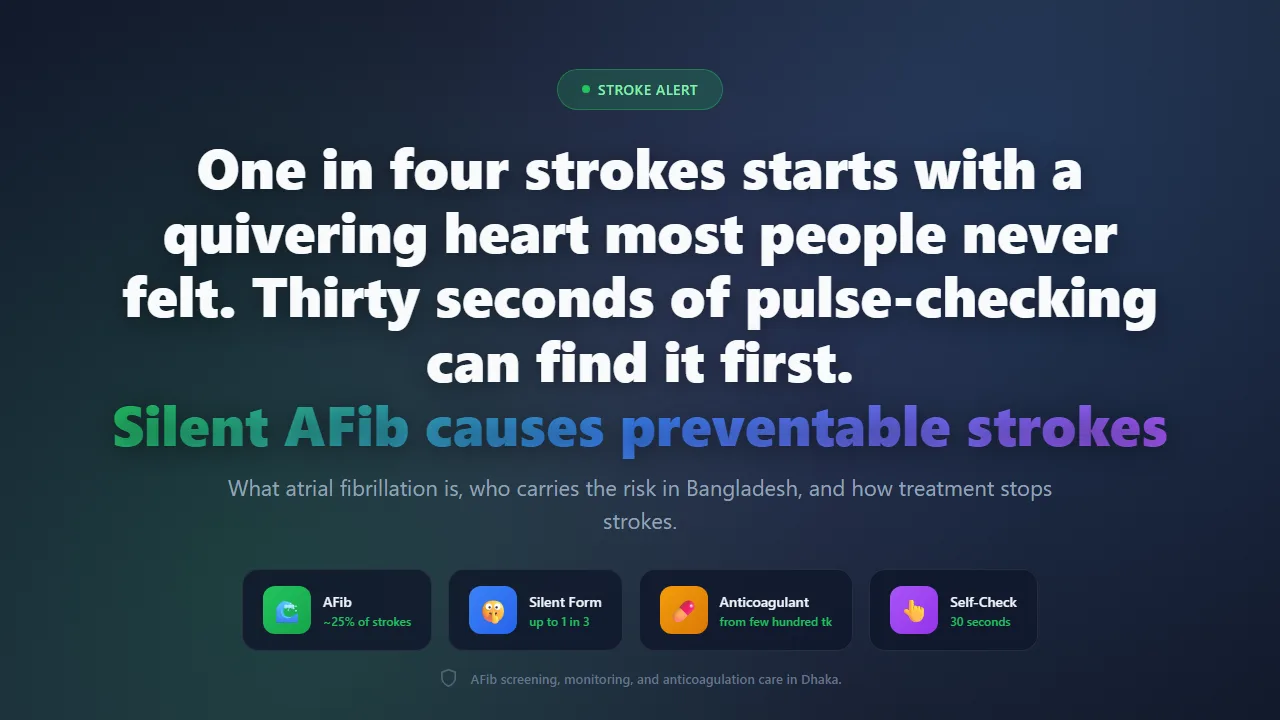
Ask most people in Dhaka what causes stroke and they will say high blood pressure, maybe diabetes. Almost nobody names atrial fibrillation. Yet AFib is responsible for roughly one in every four ischaemic strokes, and the strokes it causes tend to be among the most disabling. The cruelest part: many people carry AFib for years without feeling a single symptom until the day a clot reaches the brain.
This is the one heart condition where finding it before you feel it genuinely changes your future.
What Happens in Atrial Fibrillation
Your heart’s upper chambers, the atria, normally squeeze in coordinated rhythm, pushing blood into the lower chambers with each beat. In AFib the atria stop squeezing and quiver instead, firing electrical impulses at 350 to 600 times per minute while the ventricles respond in an irregular, often fast pattern.
Two problems follow. First, the pulse becomes fast and erratic, causing palpitations, fatigue, and breathlessness. Second, and far more dangerous: because the left atrium, especially its small appendage pocket, is no longer being emptied by contraction, blood stagnates there. Stagnant blood clots. A piece of that clot can break loose, travel up the aorta into the brain circulation, and block an artery.
An AFib-related stroke tends to be larger and more damaging than average, precisely because the clot comes pre-formed from the heart.
Why AFib Matters So Much in Bangladesh
Several realities make AFib a quiet epidemic here:
- An ageing population. AFib risk roughly doubles each decade after 55. More Bangladeshis are now living into their seventies than ever.
- Uncontrolled hypertension and diabetes, both widespread and both major AFib drivers.
- Rheumatic heart disease still exists in our region and damages the atria in ways that promote fibrillation at younger ages.
- Obesity, sleep apnoea, and thyroid disease, all rising or under-diagnosed.
- Low detection rates. Without routine pulse checks or ECG screening, intermittent AFib simply goes unseen. Studies worldwide suggest a substantial share of AFib is first discovered on the day of the stroke it caused.
Estimates suggest over 1 percent of all adults have AFib, climbing past 5 to 10 percent in people over 70. Applied to Bangladesh’s population, that means millions of people, most undiagnosed.
Symptoms: Loud, Subtle, and Silent
AFib announces itself differently in different people:
The obvious form: sudden palpitations, a racing irregular heartbeat, sometimes with chest discomfort, sweating, and anxiety. Episodes may last minutes or never stop without treatment.
The subtle form: unexplained tiredness, breathlessness climbing stairs that used to be easy, reduced exercise tolerance, mild dizziness. Middle-aged patients often blame age or workload while their heart has been fibrillating for months.
The silent form: nothing whatsoever. Up to a third of AFib patients have no perceivable symptoms. They discover it on a routine ECG, on a smartwatch alert, or in the emergency room mid-stroke.
One classic clue anyone can check: feel your own pulse at the wrist during symptoms. AFib produces an irregularly irregular rhythm, beats coming with no pattern at all, unlike the steady drumming of exercise or anxiety.
The Numbers Behind the Risk
Untreated AFib raises stroke risk about five-fold compared with a normal rhythm. But the risk is not uniform; it depends on other conditions. Doctors score this with the CHA2DS2-VASc system, adding points for congestive heart failure, hypertension, age 65 or older (more above 75), diabetes, prior stroke, vascular disease, and female sex.
A low-scored young patient with lone AFib may need no blood thinner at all. A 68-year-old with hypertension and diabetes carries an annual stroke risk high enough that anticoagulation is not optional. This scoring is exactly why professional assessment matters: both over-treatment and under-treatment cause harm.
Finding AFib: Easier Than You Think
Because AFib can be intermittent, detection uses a ladder:
- Pulse self-check. Thirty seconds at the wrist weekly if you are over 50. Irregular means get an ECG.
- Resting 12-lead ECG, which catches permanent AFib instantly and costs a few hundred taka.
- Pocket ECG recordings during symptoms, ideal for intermittent episodes, available from around 2,000 taka with specialist review at Rhythm Care Ltd.
- Extended monitoring, Holter or longer patch wear, when suspicion stays high despite clean snapshots.
If you have already had a small stroke whose cause was never found, insist on rhythm monitoring before accepting “unknown cause.” Occult AFib hides behind a significant fraction of these events, and finding it changes prevention completely.
Treatment: Two Separate Jobs
Treating AFib means answering two independent questions, and mixing them up is the most common mistake in casual care.
Job one: prevent stroke (the priority)
Anticoagulants, blood thinners, stop clots forming in the stagnant atrium. Options include warfarin, cheap but needing regular INR blood tests and dietary care, and the newer direct oral anticoagulants such as apixaban and rivaroxaban, which need no routine monitoring. Generics have brought DOAC prices down to roughly 2,000 to 4,500 taka monthly in Bangladesh, affordable for many families and vastly cheaper than the cost of a major stroke.
For patients who cannot take long-term anticoagulants, procedures exist to seal off the left atrial appendage where clots form. These remain specialised and costly but available in advanced Dhaka centres.
Job two: control rate or rhythm
Beta blockers or calcium channel blockers keep the ventricular response reasonable, often resolving fatigue and breathlessness entirely. Rhythm-control options include antiarrhythmic medicines and catheter ablation, where the triggers inside the pulmonary veins are cauterised. Ablation succeeds in keeping 60 to 80 percent of patients free of AFib long term, higher with early treatment, and is increasingly performed in Dhaka, typically costing 3 to 6 lakh taka depending on the hospital.
Which combination suits you depends on age, symptom burden, AFib type, and heart structure. That decision deserves a cardiologist who manages rhythm problems regularly, not a one-size answer.
Living With AFib
Well-treated AFib does not stop normal life. Patients travel, work, and exercise on anticoagulation every day. Practical points:
- Never stop a blood thinner without cardiology guidance, even before dental work; tell your dentist instead.
- Keep blood pressure and diabetes tightly controlled; they feed AFib progression.
- Weight loss of even 10 percent measurably reduces AFib burden.
- Treat sleep apnoea if present; it is one of the strongest modifiable drivers.
- Limit alcohol, which provokes episodes, and moderate caffeine rather than fearing it entirely.
- Learn your episode pattern and record early with a pocket device so recurrences get caught fast.
Frequently Asked Questions
Can AFib be cured?
Catheter ablation cures or controls it in most patients, especially when treated early and when episodes are paroxysmal. Others manage well for decades with medicines alone.
Is AFib fatal by itself?
No, but its complications, chiefly stroke and heart failure, are serious. That is exactly why detection and anticoagulation matter so much.
I am only 45 and fit. Can I still have AFib?
Yes, particularly with thyroid disease, heavy alcohol use, sleep apnoea, or a family history. Young patients with AFib deserve thorough evaluation, including thyroid tests and echo.
Are blood thinners dangerous? Do they cause brain haemorrhage?
They raise bleeding risk modestly, but for patients with elevated stroke scores, the arithmetic strongly favours them: preventing a devastating stroke outweighs a manageable bleeding risk in the great majority of cases.
Can I check myself at home?
Yes. Feel your wrist pulse during any episode. Irregular chaos warrants a recording and an ECG. Smartwatches also flag suspected AFib, though confirmatory testing always follows.
Does every AFib patient need ablation?
No. Many do excellently with rate control plus anticoagulation. Ablation enters mainly when symptoms persist despite medication or when early intervention offers clear benefit.
Check Your Pulse. It Takes Half a Minute.
If you are over 50, have high blood pressure or diabetes, or ever feel an odd flutter, do yourself one favour this week: check your pulse properly, and if anything feels irregular, get an ECG and a recording.
Rhythm Care Ltd screens for, diagnoses, and manages AFib in Dhaka with modern monitoring and clear guidance on stroke prevention. Book through our appointment page today. A thirty-second habit could spare you years of regret.
*General information only; personal decisions need individual medical assessment.*






Leave a Comment