


Heart failure is a chronic condition, not a single event. The heart pumps less effectively than the body needs, and without proper treatment it tends to worsen year by year. The encouraging part is that modern treatment genuinely changes that curve. Patients diagnosed today who receive the right combination of medicines, and devices where indicated, live longer and stay out of hospital far more than patients did a generation ago.
This guide explains how heart failure is treated in Bangladesh in 2026, from first-line medicines through pacemakers, CRT devices and advanced options, along with what each stage costs.
First: confirm the diagnosis and find the cause
Treatment begins with knowing what kind of heart failure you have. Standard workup includes:
- Echocardiogram, which measures the ejection fraction, the key number describing pumping strength
- ECG, which shows rhythm problems and electrical delay
- Blood tests, including NT-proBNP, kidney function and iron studies
- Sometimes coronary angiography, since blocked arteries are a leading cause
The cause shapes everything afterwards. Heart failure from narrowed arteries needs artery treatment as well as heart failure medicines. Heart failure from valve disease may need valve repair. Treating the underlying cause is often as important as any medicine.
Core medications: the foundation
For heart failure with reduced ejection fraction (usually EF below 40%), international guidelines and Bangladeshi practice align on four drug classes, started early and titrated upward:
| Drug class | Common examples in Bangladesh | Approximate monthly cost |
|---|---|---|
| ARNI or ACE inhibitor/ARB | Sacubitril/valsartan, enalapril, losartan | BDT 500 – 4,000 |
| Beta blocker | Carvedilol, bisoprolol, metoprolol | BDT 200 – 800 |
| MRA (mineralocorticoid receptor antagonist) | Spironolactone, eplerenone | BDT 100 – 600 |
| SGLT2 inhibitor | Dapagliflozin, empagliflozin | BDT 400 – 1,200 |
Generic versions keep costs manageable for most families; imported brands sit at the top of each range. Diuretics such as furosemide are added for fluid overload and swelling. Newer agents like ivabradine or vericiguat enter the picture in selected patients.
The honest truth about medicines: they work only when taken consistently and pushed toward target doses over months. Many patients in Bangladesh take low doses indefinitely and miss the benefit. Regular follow-up with blood tests allows safe up-titration, which is where much of the survival gain lives.
When medicines are not enough: device therapy
If symptoms persist despite good medical therapy, devices enter the conversation. Three main categories exist.
Pacemakers
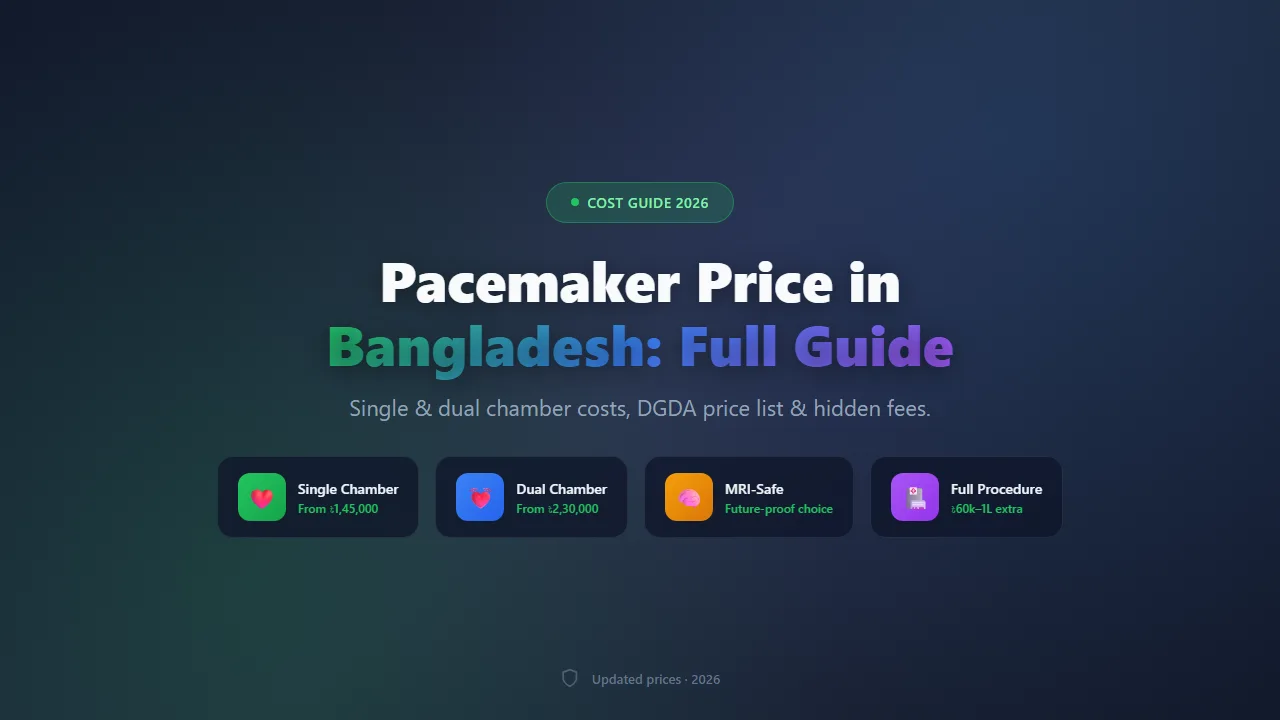
For hearts that beat too slowly, a standard pacemaker corrects the rate. Costs run roughly BDT 1,50,000 to 4,00,000 depending on type. See our guide on pacemaker prices in Bangladesh for details.
ICDs
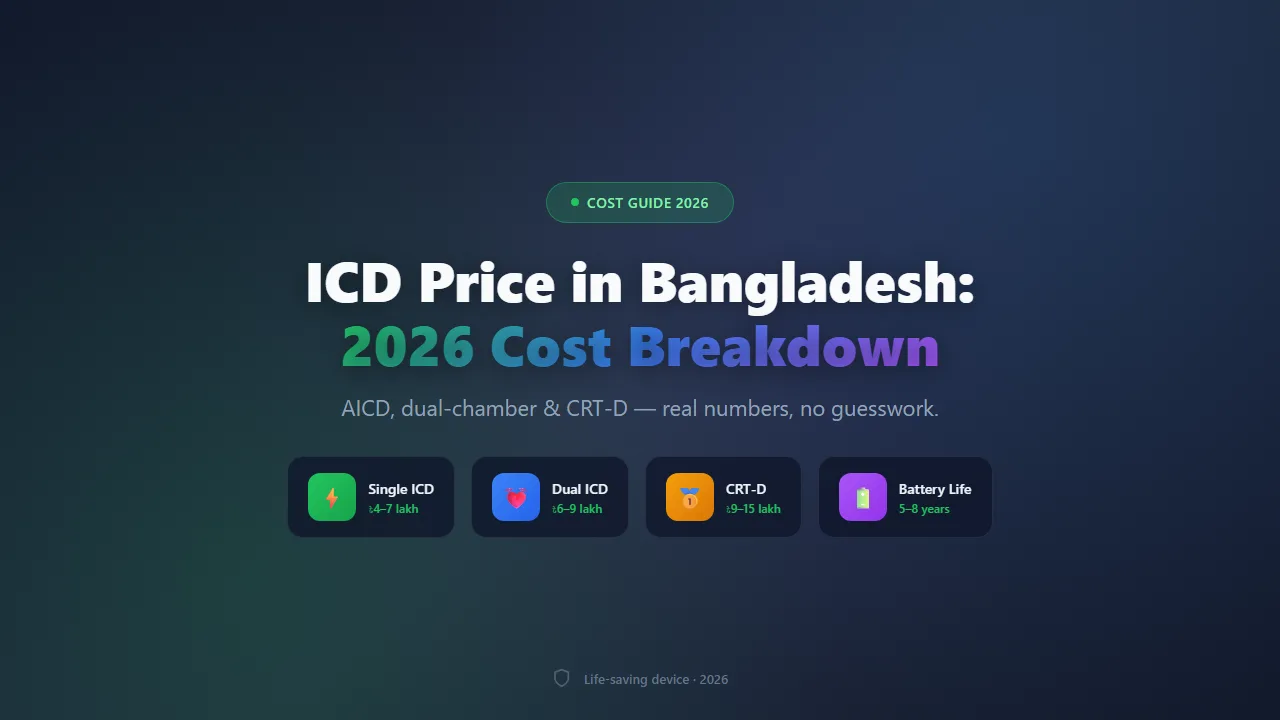
For hearts weak enough to be at risk of sudden cardiac arrest, an ICD monitors continuously and shocks the heart out of lethal rhythms. Device prices start around BDT 4,00,000 for single-chamber models. Our ICD price guide covers this in depth.
CRT devices
For heart failure combined with electrical delay (a wide QRS or left bundle branch block on ECG), a biventricular device paces both ventricles together, improving pumping efficiency. About two-thirds of correctly selected patients respond with better function and fewer hospitalizations. CRT-P devices run BDT 5,00,000 to 8,50,000 and CRT-D devices BDT 9,00,000 to 15,00,000+, plus procedure costs of BDT 80,000 to 1,50,000.
The sequence matters: devices supplement optimized medicines, they do not replace them. Guidelines expect patients to be on tolerated guideline doses before judging whether a device is needed.
Procedures and advanced options
Beyond medicines and implants, several interventions address specific causes:
- Angioplasty or bypass surgery (CABG) when blocked coronary arteries drive the failure. Restoring blood flow to stunned heart muscle can substantially improve pumping.
- Valve repair or replacement for significant mitral regurgitation or aortic valve disease, including transcatheter options in selected patients.
- Cardiac rehabilitation: structured, supervised exercise programs that measurably reduce readmission rates.
- Implantable loop recorders for unexplained fainting episodes in heart failure patients.
For the small group with end-stage failure where nothing else works, heart transplantation exists in Bangladesh at limited centers abroad referral pathways, and mechanical pumps remain rare due to cost. These are last-resort conversations guided by a specialist team.
Lifestyle measures that carry real weight
Medicines do the heavy lifting, but daily habits decide how well they work:
- Limit salt strictly; excess sodium drives fluid retention and admissions
- Weigh yourself daily; a gain of two kilograms in three days signals fluid buildup worth calling about
- Take fluid restriction seriously when your doctor sets one
- Stop smoking completely and limit alcohol
- Stay active within prescribed limits; bed rest worsens deconditioning
- Get flu and pneumonia vaccinations, since chest infections commonly trigger admissions
What follow-up looks like
Heart failure care is longitudinal. Expect visits every one to three months while doses are being adjusted, then every six months once stable, with periodic echocardiograms and kidney/electrolyte blood tests. Remote device monitoring applies if you have an implanted device.
Skipping follow-up is the most common way good initial treatment quietly falls apart, because doses never reach targets and side effects go unmanaged.
Frequently asked questions
Can heart failure be cured?
Most cases are managed rather than cured, but treatment can restore substantial function. Heart failure caused by blocked arteries or valve disease sometimes improves markedly once the cause is fixed.
How much does monthly medicine cost?
Core heart failure medicines run roughly BDT 1,200 to 6,600 per month depending on brands, with generics at the lower end.
When is a pacemaker needed in heart failure?
Standard pacemakers treat slow rhythms; biventricular (CRT) devices treat pumping coordination problems when EF is low and QRS is wide.
Are heart failure treatments available outside Dhaka?
Basic medicines are widely available nationwide. Device implantation and advanced procedures concentrate in Dhaka and a few other major cities.
How often should a heart failure patient see a doctor?
Every one to three months while doses are being adjusted, then every six months once stable, with periodic blood tests and echocardiograms.
Getting treated in Dhaka
Rhythm Care Ltd manages heart failure from diagnosis through medication optimization, device candidacy assessment, and long-term follow-up. If your recent echo showed a reduced ejection fraction, or you are repeatedly admitted with fluid overload, bring your reports to a consultation. Book an appointment to review your current regimen and find out whether anything in it should change.


Leave a Comment