
![final-logo[1]](https://rhythmcareltd.com/wp-content/uploads/elementor/thumbs/final-logo1-scaled-e1746056972397-scaled-ruqy3bwsz2r7w21yid55zivnvu9pr54am1hccjtohw.webp "final-logo[1]")

Your heart beats about 100,000 times a day without you noticing. But when it starts beating noticeably slower than it should, the body sends signals: dizziness when you stand, unusual tiredness by mid-afternoon, sometimes a faint that frightens the whole family. Doctors call this bradycardia, and it is one of the most common reasons patients come to see us at Rhythm Care Ltd in Dhaka.
The good news is that bradycardia is one of the most treatable rhythm problems in cardiology. This article explains what counts as too slow, what causes it, which symptoms deserve attention, and when a pacemaker becomes the right answer.
What Is Bradycardia?
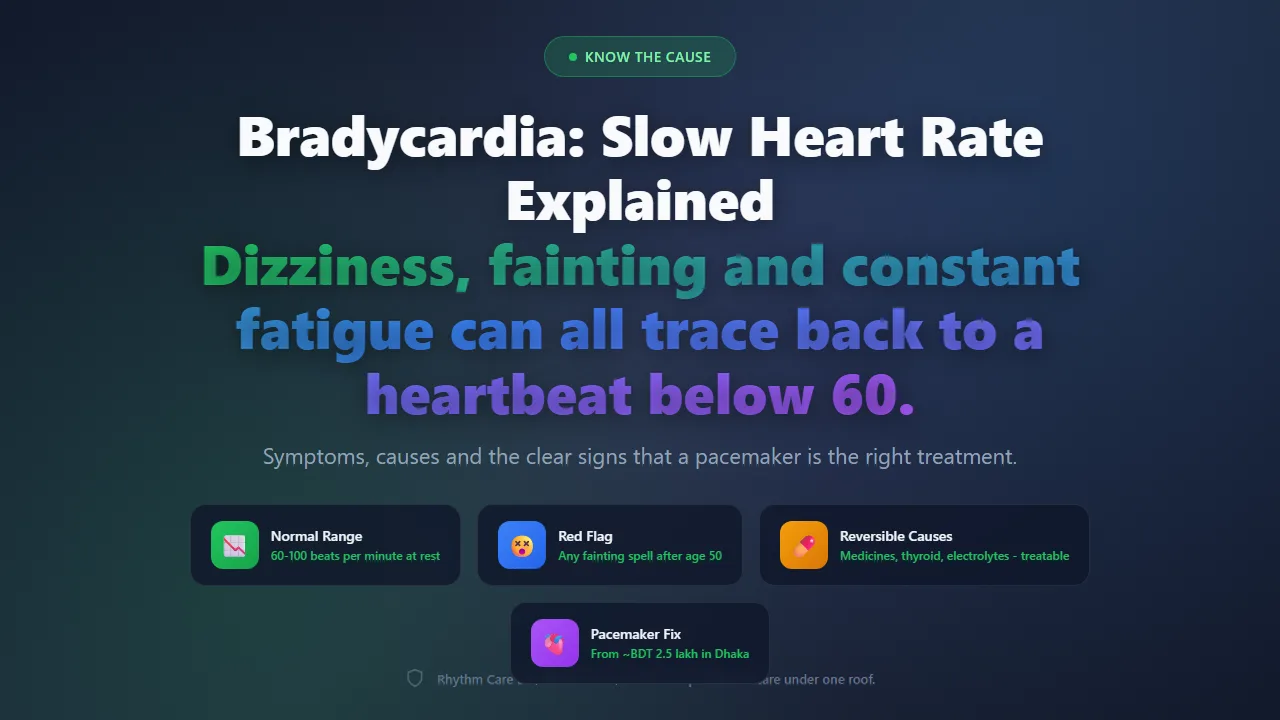
Bradycardia means a resting heart rate below 60 beats per minute. For context:
- A normal adult heart rate at rest runs 60 to 100 beats per minute
- Trained athletes can sit naturally at 45 to 55 and be perfectly healthy
- Rates below 50 with symptoms usually need investigation
So the number alone does not decide anything. A fit 30-year-old jogger with a pulse of 52 needs nothing. A 68-year-old on blood pressure medicine with a pulse of 48 who feels dizzy every morning needs a cardiologist this week.
Symptoms of a Slow Heart Rate
Mild bradycardia often causes no symptoms at all. When the rate drops enough to reduce blood flow to the brain and body, these appear:
- Fatigue that rest does not fix; feeling drained by tasks you handled easily before
- Dizziness or lightheadedness, especially when standing up
- Fainting or near-fainting spells (syncope), the most serious warning sign
- Shortness of breath during mild activity
- Confusion or memory fog in older adults, sometimes mistaken for early dementia
- Chest discomfort during exertion
- Weakness that makes climbing stairs or carrying shopping harder
In elderly patients especially, unexplained falls and sudden confusion are sometimes the only clues. Families frequently attribute these to age or weakness when a slow rhythm is quietly responsible.
What Causes Bradycardia?
Natural ageing
The most common cause in Bangladesh. The sinoatrial node, your heart’s natural pacemaker, loses cells over decades. By the seventies many people have some degree of “sick sinus syndrome,” where the node fires too slowly or pauses altogether.
Heart block
The electrical signal travels from the upper chambers to the lower chambers through conduction tissue. If that pathway gets damaged, signals are delayed or blocked entirely. First-degree block is mild and often harmless. Second-degree and third-degree (complete) heart block are serious; in complete block the heart may beat as slowly as 25 to 40 per minute.
Common causes of heart block include prior heart attacks, heart muscle disease, infections, and degeneration with age.
Medicines
This cause gets missed constantly. Common drugs slow the heart:
- Beta blockers (metoprolol, bisoprolol, atenolol)
- Certain calcium channel blockers (diltiazem, verapamil)
- Digoxin
- Some antiarrhythmics
Sometimes adjusting the dose solves the problem without any device. Never stop prescribed heart medicines on your own though; bring the full list to your doctor.
Thyroid problems
An underactive thyroid slows everything down, including the heart. It is common in Bangladesh, easily checked with one blood test, and fully treatable.
Other causes
Electrolyte imbalances (especially high potassium), sleep apnea, untreated obstructive jaundice, Lyme-like infections, rheumatic heart disease from untreated childhood strep throat, and congenital conduction abnormalities in younger patients.
How Is Bradycardia Diagnosed?
A single ECG captures maybe ten seconds of your heart. If the slowness comes and goes, it will be missed. Proper evaluation usually involves:
- 12-lead ECG for baseline conduction patterns
- 24-hour or longer Holter monitor recording every heartbeat through a full day and night
- Event recorder or implantable loop recorder for rare, fleeting episodes
- Echocardiogram to check heart structure and pumping function
- Blood tests for thyroid, electrolytes, and kidney function
At Rhythm Care Ltd we start almost every suspected bradycardia workup with a Holter because intermittent pauses between beats are what actually make people faint, and those pauses hide from ordinary ECGs.
When Is a Pacemaker Needed?
Not every slow heart needs a device. The decision follows clear international guidelines:
Pacemaker clearly indicated when:
- Complete (third-degree) heart block exists, whether or not symptoms are present
- Fainting has been proven to come from heart pauses, typically pauses longer than 3 seconds while awake
- Symptomatic sick sinus syndrome persists despite treating reversible causes
- Symptoms directly match documented slow rhythms on monitoring
- Required heart medicines keep causing dangerous slowing and cannot be reduced
Pacemaker usually not needed when:
- The slowness causes no symptoms and there is no dangerous block
- A reversible cause explains it (medicine side effect, thyroid, electrolytes)
- The person is a trained athlete with low resting rate and no symptoms
If you want a realistic picture of what treatment costs, our pacemaker price in Bangladesh page lists current figures for single-chamber, dual-chamber, and advanced devices.
Living With Treatment
For reversible causes, fixing the root problem restores normal rhythm. For permanent node failure, a pacemaker is genuinely life-changing. Most implanted patients report within weeks that fatigue lifts, dizziness stops, and the fear of fainting disappears. Implantation itself takes about an hour under local anaesthesia, and most patients walk the next day.
Bradycardia vs Other Causes of Fatigue: Why Testing Matters
Fatigue and dizziness are famously non-specific. Anaemia causes them. Low blood pressure causes them. So do depression, poor sleep, uncontrolled diabetes, and dozens of other conditions common in Bangladesh. This overlap is exactly why self-diagnosis fails and testing matters.
A useful way to think about it: bradycardia symptoms share one pattern. They worsen with upright activity and improve when lying flat, because lying down helps a slow heart fill better. Symptoms that follow that gravity pattern, plus a low measured pulse, raise suspicion enough to justify a Holter monitor.
Conversely, if your resting pulse sits comfortably at 65 to 80 and you still feel exhausted, a slow heart is unlikely to be the culprit, and your doctor should look elsewhere. Either way, one ECG plus one Holter settles months of guessing.
Can Bradycardia Be Prevented?
Not the age-related kind; node cells wear out like any other tissue, and no supplement reverses that. But you can reduce the preventable fraction:
- Treat high blood pressure properly, since chronic hypertension damages conduction tissue over decades
- Control diabetes, which accelerates blood vessel damage feeding the heart’s electrical system
- Never ignore chest pain; heart attacks are a leading cause of permanent heart block
- Get thyroid checked during routine annual tests, especially after 50
- Review your medicine list with a doctor yearly so accumulating doses do not quietly overshoot
- Treat sleep apnea if you snore heavily and wake unrefreshed
None of these guarantee anything, but together they lower the odds of needing a device early in life.
Frequently Asked Questions
Is a heart rate of 55 dangerous?
On its own, usually not, especially if you feel well and take no heart-slowing medicines. Danger comes from symptoms plus documented pauses or block, which need monitoring to confirm.
Can bradycardia go away without treatment?
Reversible causes yes: adjust the drug, correct the thyroid, fix the electrolytes. Age-related node failure does not reverse, but a pacemaker removes its consequences completely.
What heart pause length is dangerous?
Pauses beyond 3 seconds during waking hours generally meet criteria for pacing, particularly if they cause dizziness or fainting.
Which test confirms bradycardia best?
A Holter monitor, because it records continuously and catches intermittent pauses a clinic ECG misses.
—
Feeling constantly tired or dizzy and unsure why? Get a proper rhythm evaluation at Rhythm Care Ltd, Dhaka, starting with ECG and Holter testing. Book an appointment today.






Leave a Comment